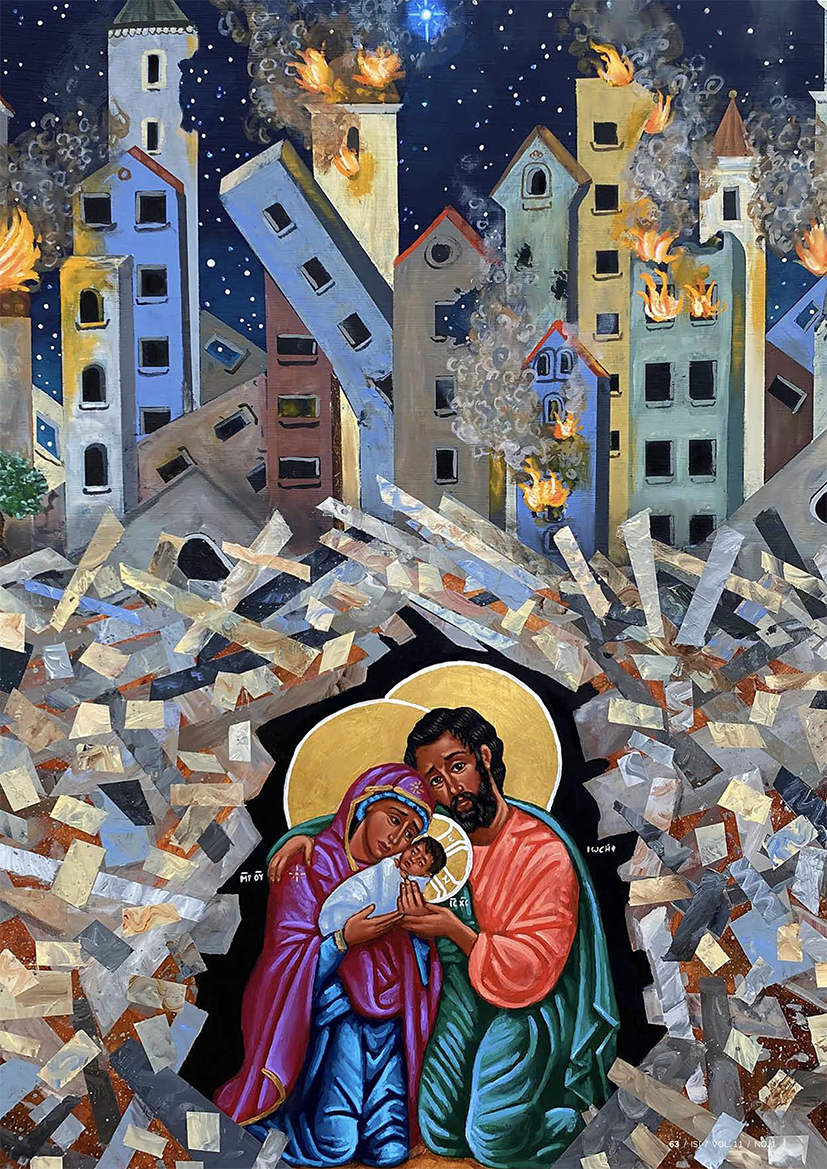
The following post is a review of the book by Palestinian minister Munther Isaac. The organization I work for, Scholar Leaders, has partnered with and supported Dr. Isaac over the years. The review below is written by my colleague Juliany González Nieves for InSights Journal, which is available for free online along with the other articles from that issue. I’ve also included a short video clip from CBS from a couple years ago when they interviewed Dr. Isaac about his work.
Book Review of “Christ in the Rubble: Faith, the Bible, and the Genocide in Gaza”
Guest post by Juliany González Nieves
“I am not a politician. I am a theologian by training and a pastor to multiple churches, and, for me, speaking about Gaza is primarily a pastoral mandate” (1). With these words, Rev. Dr. Munther Isaac greets readers, positioning himself vocationally, and pinpointing the impetus behind his most recent book, Christ in the Rubble: Faith, the Bible, and the Genocide in Gaza. But these words do more than that. They also establish the book’s tone and approach, for while the book can be accurately described as a careful and well-documented interweaving of historical, socio-political, and theological accounts, at its core it remains an impassioned pastoral plea. His aim is not only to explain Gaza’s man-made devastation – and the actors, interests, and factors that have led to it – but also to call the global Church to a faithful response to such horror. As noted by New Testament scholar Willie James Jennings in the foreword, Munther is writing to make people see, unwilling to let us be captive “to a piety that excuses violence; a theology that baptizes territory, nation, state, property, and military actions as ordained by God; and a faith that believes that God uses people like chess pieces on a board and sanctifies homicide or genocide as holy collateral damage for God’s glory” (xii).
Published almost a year and a half after the October 7 Hamas attacks – and 77 years since the beginning of the Nakba – the book could be read as following a tripartite structure. Chapters 1-3 provide insightful and necessary historical and political context. Isaac expertly balances the general and the particular, providing the reader with an accessible socio-political and historical brief of key events and arrangements of power that have defined Palestinian life during the past 76 years. Chapters 4-6 dissect how coloniality, racism, and theology have enabled what we are witnessing in Gaza today and how the Western Church has, as argued by the author, been complicit in it. The third section, chapters 7 through the epilogue, is an urgent sermonic plea that intertwines Christology and ecclesiology, calling the Church to repentance and back to its calling, which requires the embodiment of costly solidarity. Isaac concludes his book with a moving discourse on hope and an affirmation of the Palestinian people’s “commitment, resolve, and defiance […] [t]o survive. To exist. To insist that God is good,” and to recover (265-66).
The author’s central argument is that what is being perpetrated in Gaza – and Palestine – is not merely a political crisis to be debated but a theological and pastoral emergency that demands a response from the global Church. He insists that Christ is present “in the rubble,” among the suffering, displaced, and bombed. So, any theology that justifies, excuses, or ignores Palestinian oppression is a betrayal to the gospel. To follow Christ faithfully, then, requires seeing Christ in Gaza’s agony, naming what is happening as genocide, repenting from our complicity, and bearing witness through lament, solidarity, and prophetic witness.
Assessment
One of the book’s notable strengths is its conceptual clarity, which reinforces both its pedagogical approach and central argument. Isaac skillfully identifies and addresses common misconceptions about the situation in Palestine, clarifying terms that are often invoked yet rarely explained – particularly in Western mainstream media – such as settler-colonialism, Palestinian-Israeli conflict, the Nakba, apartheid, ethnic cleansing, Zionism, and state theology. This precision not only equips readers to engage the discourse with greater understanding but also challenges the vague or misleading language that too often obscures the realities of Palestinian suffering.
Working in tandem with this conceptual clarity is the book’s thorough documentation. Isaac grounds his argument in a wide range of official reports, journalistic accounts, scholarly works, and other relevant publications. The careful use of sources, and the way in which he weaves them seamlessly into his argument, not only strengthens his claims but also renders the book both accessible and compelling.
Building on this foundation of conceptual clarity and rigorous documentation, the author’s prophetic and pastoral voice imbues his argument with distinctive urgency and moral weight, calling readers not merely to understand but to respond faithfully. This pastoral dimension is vividly illustrated by the inclusion of excerpts from several of his sermons, including the one he delivered on Sunday, October 8, 2023, the “Christ in the Rubble” sermon preached on Christmas Eve that same year, and a sermon at Bloomsbury Central Baptist Church in London in February 2024. These homiletic passages allow readers to encounter firsthand Isaac’s pastoral concern at crucial moments.
Beyond these strengths, two particular contributions deserve more detailed consideration. The first is Isaac’s conceptual mapping of how racism, colonization, and theology – specifically state or empire theology – intersect to fuel the genocidal campaign in Gaza. The second is his articulation of sumud, a deeply rooted Palestinian commitment to steadfastness, which he briefly develops into a theological category with both pastoral and ecclesial significance in the epilogue.
Theological Discourses at the Service of Death
Theological discourses are never neutral, nor do they unfold in isolation from the world. They are shaped by, and in turn shape, socio-political, historical, economic, and cultural realities – at times challenging them, other times reinforcing them. In the case of Gaza and Palestine, Isaac identifies how coloniality, racism, and empire theology converge to sustain Western complicity in genocide.
He writes, “coloniality, racism, and empire theology […] work hand in hand in the context of Palestine. Coloniality is based on racism – the belief that some people groups have less dignity and worth than others […] Empire theology justifies and gives legitimacy to the sins of coloniality and racism (103).”
To “give legitimacy” here is nothing less than to baptize sin as the will of [g]od. Isaac’s analysis on this matter resonates with Cameroonian philosopher Achille Mbembe’s work on necropolitics. For Mbembe, our contemporary social state is one of enmity, in which arrangements of power determine who may live and who must die. It is a world forged through “the sacramentalization of war and race in the blast furnace of colonialism” (Mbembe, 6) and characterized by the proliferation of “theaters of terror and counter terror” (Mbembe, 38). Within such a world, some theological discourses are often co-opted into the service of death.
If the Church and its training institutions are to serve as “theaters of liberation” – that is, “as a communal witness to the reality that another world is possible, characterized by justified people acting justly, […] being visible ‘spec-actors’ of God’s justice-making activity,” (Martínez Olivieri, 193), then we must take Isaac’s argument with utmost seriousness. Moreover, his account of how theological discourses have devolved into theologies of genocide in Gaza must compel us to examine how similar theological logics continue to sanctify politics of death in many other contexts. Theological institutions, therefore, must recognize that we are preparing Christian leaders to serve in a world where necropower is not peripheral but a defining backdrop for theological reflection and praxis.
Sumud
If Isaac’s discussion on coloniality, racism, and empire theology reveals how theology has been co-opted into the service of death, his second major contribution points us toward life. Although the explicit articulation of sumud appears only in the book’s epilogue, it permeates the entire work. Indeed, Isaac embodies it throughout the book’s tone, structure, and content, particularly the stories and sermons woven through its pages. The term may come at the end, but the reality it names has been present all along.
Isaac’s articulation of sumud – steadfastness – captures the deep Palestinian resolve to endure, resist, and hope amid the relentless assaults against Palestinian life. In many ways, his theological retrieval of sumud offers a counter-theology of life and endurance in defiance of the systems of death. It is rooted in memory, land, and identity. It is a refusal to disappear, a steadfast insistence on life in the face of policies designed to erase.
As a theological concept, sumud also carries an ecclesiological dimension, one the Palestinian church has embodied in its witness. It calls the Church to be faithful to her vocation: to stand firm with those who suffer, to remember who we have been called to be, to resist structures of death without succumbing to despair, and to embody a hope that defies death. As Palestinian theologian Lamma Mansour, quoted by Isaac, reminds us,
We cannot allow our vision of what is possible to dictated by the powers and principalities of this world. We cannot leave the task of imagination to oppressors. This living hope that we have in God empowers us to envision a different reality; to challenge the imaginations of exclusion and supremacy (Isaac, 260).
By centering sumud in the epilogue, the book concludes by pointing the Church toward a praxis of faithful endurance, solidarity, and imaginative hope – offering Christian leaders both a conceptual and pastoral framework to resist theologies co-opted for death, bear witness to life amid destruction, and cultivate hope even in the face of horrific violence.
Conclusion
Christ in the Rubble stands as a profoundly important work for the global Church. Isaac combines rigorous historical, political, and theological analysis with a pastoral heart, inviting readers to see Christ amid suffering and to respond faithfully. For anyone seeking to understand the realities of Gaza and Palestinians, and for anyone who cares for the global Church’s moral and theological witness, this book offers both clarity and courage – to see and not be captive to the theologies of death and the anti-kingdoms they serve.
Author Bio: Juliany González Nieves joined Scholar Leaders in July 2024 as the Media Manager. Prior to this role, she served in multiple positions, including Director of Strategic Initiatives at Trinity International University – Florida, where she also taught undergraduate theology courses. She earned an M.Div. from Trinity Evangelical Divinity School. Juliany is passionate about doing theology in conversation with the global church. She has collaborated with projects and initiatives from institutions such as the University of St. Andrews and The Paul G. Hiebert Center for World Christianity and Global Theology.
The artwork at the top of the post is by Kelly Latimore.
References
Isaac, Munther. Christ in the Rubble: Faith, the Bible, and the Genocide in Gaza. Grand Rapids, MI: Wm. B. Eerdmans Publishing Co., 2025.
Martinez-Olivieri, Jules A. A Visible Witness: Christology, Liberation, and Participation. Minneapolis, MN: Fortress Press, 2016.
Mbembe, Achille. Necropolitics. Translated by Steven Corcoran. Duke University Press, 2019.