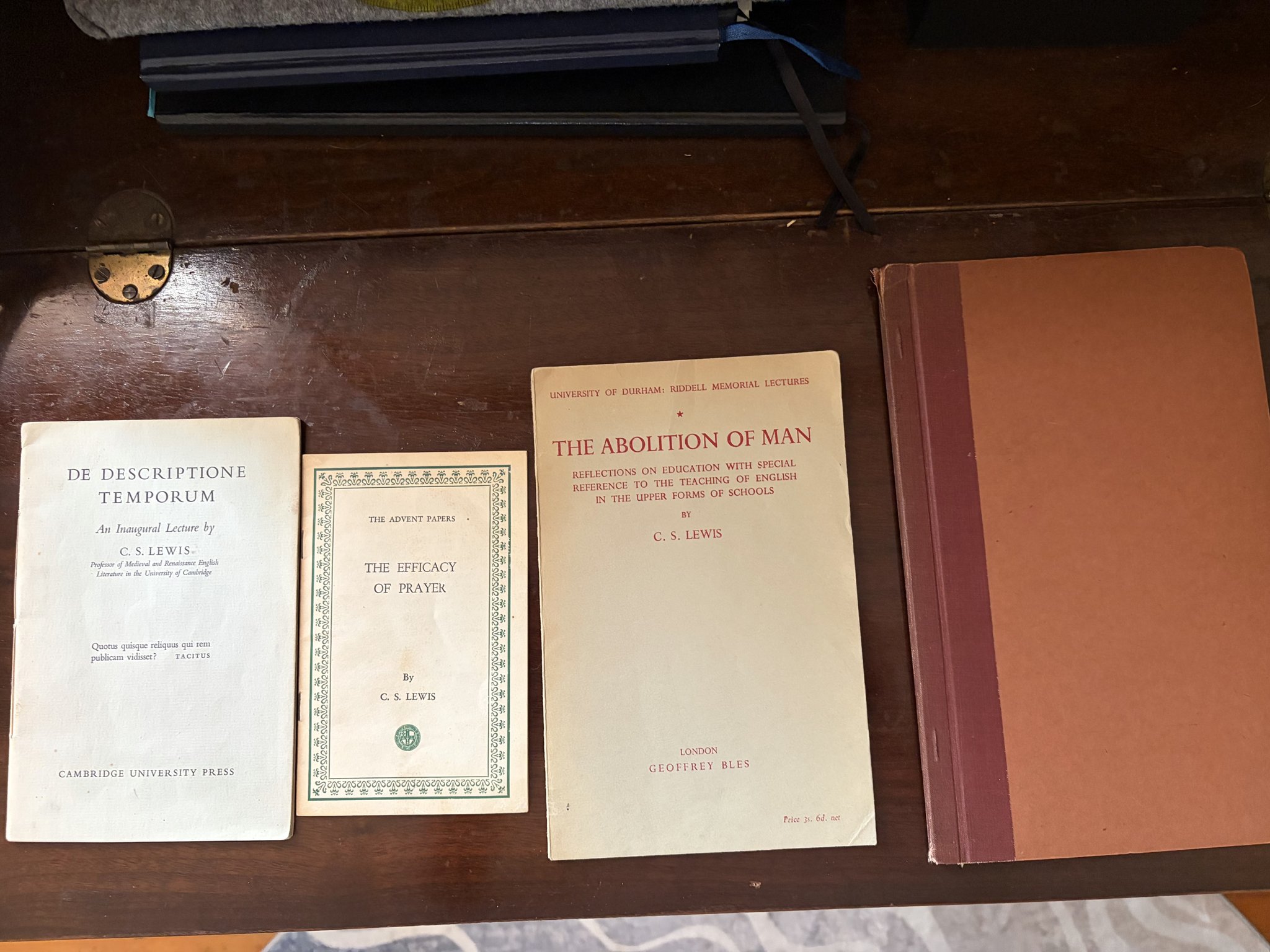
A birthday lecture that announced the death of Old Western Man, a sermon on prayer that begins at the barber’s, a wartime attack on a school textbook, and a Shakespeare lecture that told the critics they had been looking at the wrong thing. These are four of C.S. Lewis’s rare stand-alone essays, in the slim paper pamphlets in which they were first sold.
Most readers meet these pieces today bound up in collections. But each was first given as a lecture or printed as an essay of its own, and the original pamphlets were cheap, thin and easily thrown away. Few survived. This lot brings four of them together: Hamlet: The Prince or the Poem? (1942), The Abolition of Man (Geoffrey Bles, 1956 printing), De Descriptione Temporum (Cambridge University Press), and The Efficacy of Prayer (Forward Movement).
Lewis at the lectern
Lewis was famous as a lecturer long before he was famous as an author. At Oxford his lectures were so crowded that students stood in the aisles. Three of these four pamphlets began as spoken lectures, and you can still hear the voice of the room in them: the jokes, the asides to the audience, and the confidence of a man who knew his listeners were enjoying themselves.
1. Hamlet: The Prince or the Poem? (British Academy, 1942)
In April 1942, two months after The Screwtape Letters came out, Lewis was invited to give the British Academy’s Annual Shakespeare Lecture. He read it on 22 April, the eve of Shakespeare’s birthday. He opened by admitting he was no Shakespeare scholar and felt “like a child brought in at dessert” to recite before the grown-ups.
Then he went after a century of criticism. Everyone, he said, had been arguing about Hamlet’s character and why he delays. Lewis asked his audience to stop psychoanalyzing the prince and attend to the poem itself: the ghost, the night, the graveyard, the sense of a man lost in a world he does not understand. For Lewis, the real subject of the play is death. It was a provocative argument in 1942 and it is still quoted in Shakespeare studies today.
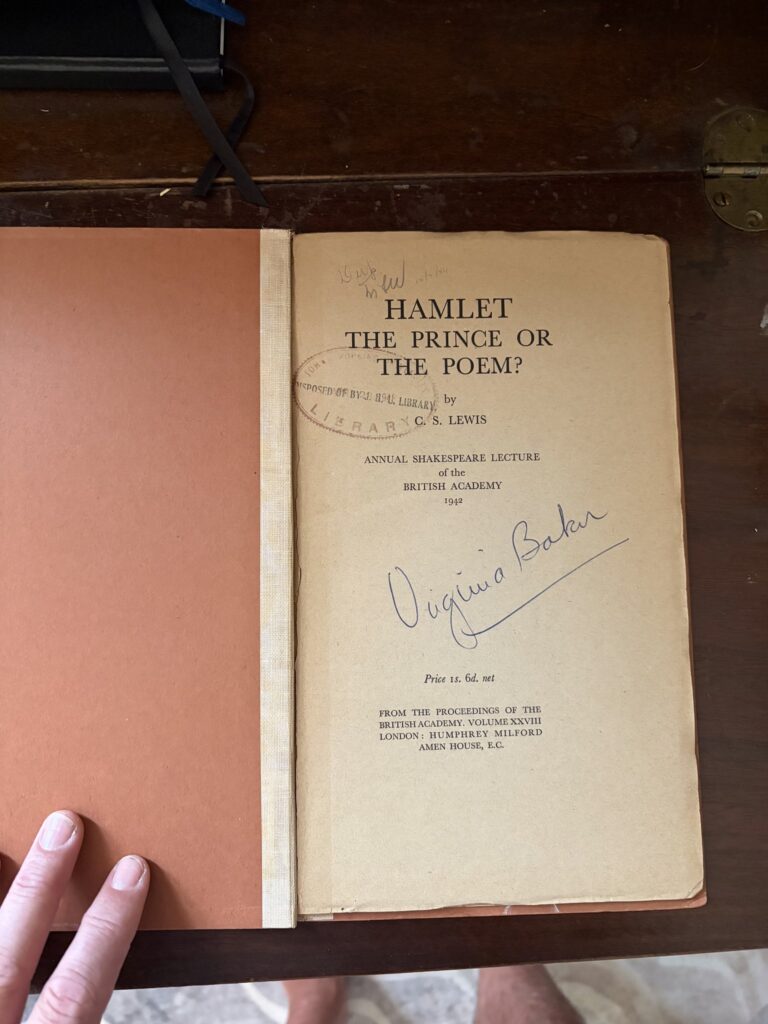
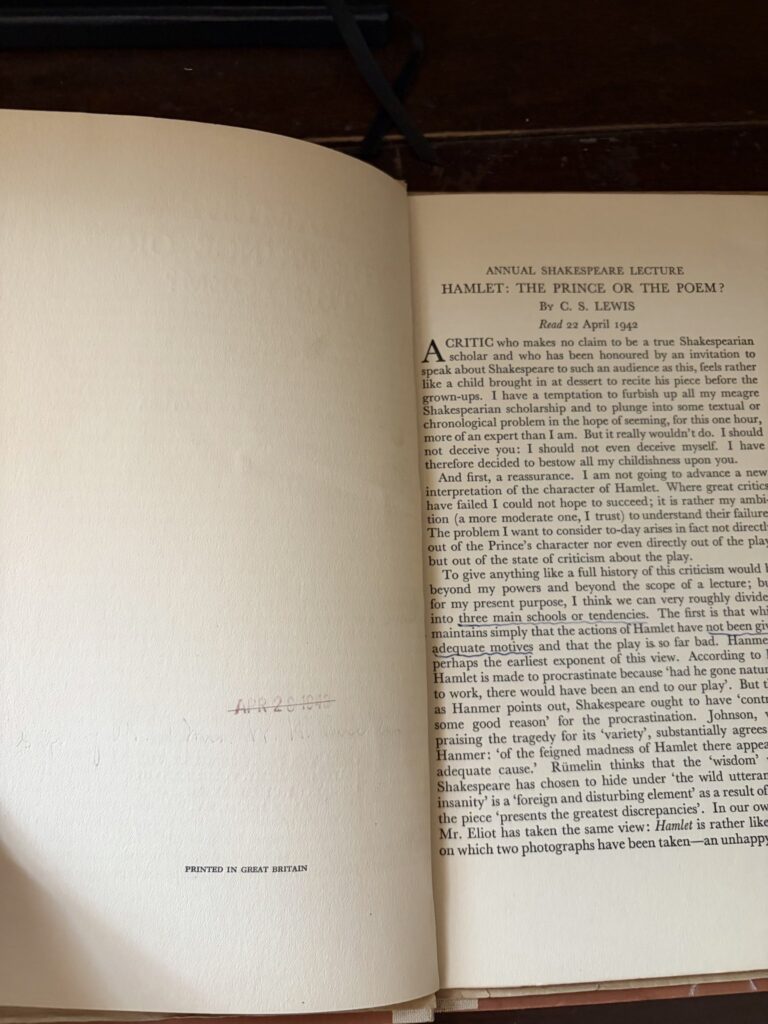
This copy: Humphrey Milford, London, 1942, from the Proceedings of the British Academy, Volume XXVIII, original price 1s. 6d. net. It has had a life of its own. It was bound into orange library boards with a cloth spine, stamped by a university library and later marked as disposed of, and it carries the bold signature of a former owner, Virginia Baker. Pencil notes sit above the title, and a reader has underlined key phrases of Lewis’s argument in blue ink on the opening page. A faded date stamp from the 1940s has been struck through on the facing page.
2. The Abolition of Man (Geoffrey Bles, 1956 printing)
In February 1943, in the middle of the war, Lewis travelled to Newcastle to give the Riddell Memorial Lectures for the University of Durham. Over three evenings, 24 to 26 February, he took aim at an unlikely target: an English textbook for schoolchildren.
He called it “The Green Book” and its authors “Gaius and Titius” to spare them embarrassment. (It was really The Control of Language, by Alec King and Martin Ketley.) Lewis seized on a passage about Coleridge at a waterfall. One tourist called it “sublime,” another “pretty,” and the textbook taught that the word “sublime” says nothing about the waterfall, only about the speaker’s feelings. Lewis saw in that small lesson a whole philosophy that would produce “men without chests”: people trained to think that nothing is truly good or beautiful.
The book has outlived its occasion. Lewis counted it among his own favorites, and National Review placed it seventh on its list of the 100 best non-fiction books of the twentieth century.
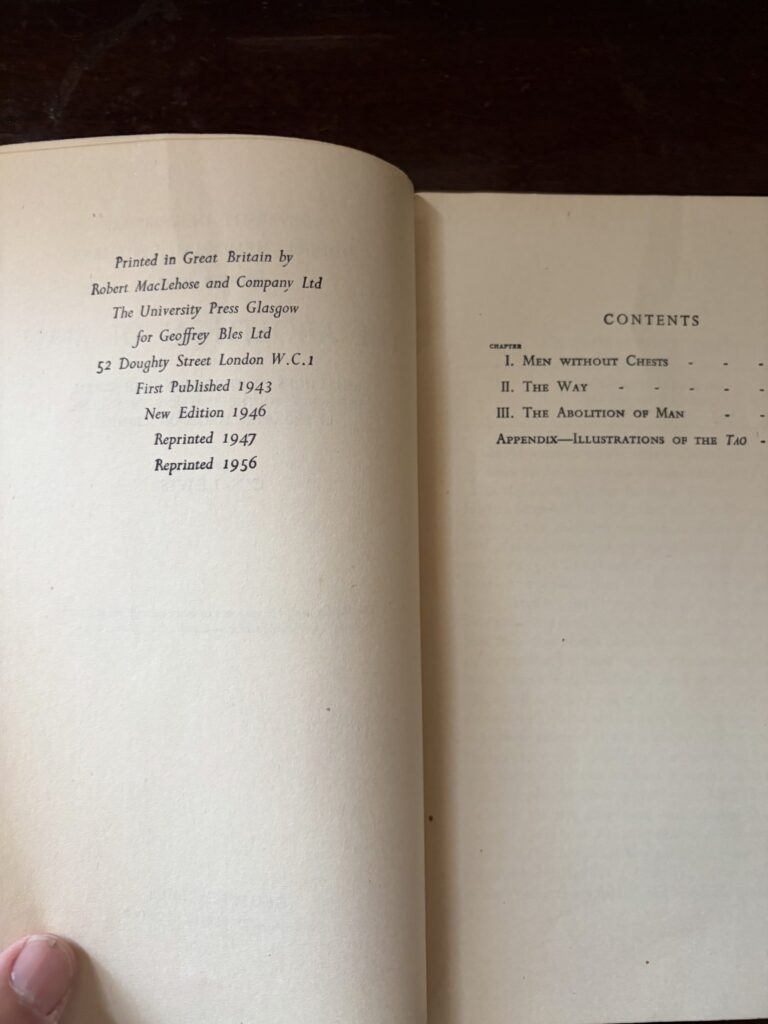
This copy: Geoffrey Bles, London, in the original printed paper wrappers with the striking red typography of the Riddell Lectures series, priced 3s. 6d. net. The imprint page records its history: first published 1943, new edition 1946, reprinted 1947 and 1956. Printed in Glasgow by Robert MacLehose and Company at the University Press, for Bles at 52 Doughty Street, London.
3. De Descriptione Temporum (Cambridge University Press)
After nearly thirty years at Oxford, Lewis was passed over for a professorship there. Cambridge created a new Chair of Medieval and Renaissance English Literature and offered it to him. He gave his inaugural lecture on 29 November 1954, his 56th birthday.
He used it to make one of the most memorable arguments of his career. The great divide in Western history, he said, did not fall between the Middle Ages and the Renaissance. It fell much later, somewhere between Jane Austen’s world and our own. Lewis then cast himself as a relic of the old order, a “dinosaur,” and told his new students to study him while they could: “There are not going to be many more dinosaurs.”
The title page carries a line from Tacitus, Quotus quisque reliquus qui rem publicam vidisset? (“How few were left who had seen the Republic?”), a quiet joke about Lewis as one of the last survivors of a vanished age.
This copy: Cambridge University Press, in the original pale blue-grey printed wrappers, with Lewis described on the cover as “Professor of Medieval and Renaissance English Literature in the University of Cambridge.”
4. The Efficacy of Prayer (Forward Movement, The Advent Papers)
This essay first appeared in The Atlantic Monthly in January 1959. It opens with one of Lewis’s best small stories. One morning he planned to get a haircut before a trip to London. The trip was cancelled, so he put off the haircut. But a nagging thought kept telling him to go anyway. When he walked in, his barber, a fellow Christian, said he had been praying Lewis would come that day.
Lewis admits he cannot prove a link between the barber’s prayer and his visit, and the essay goes on to ask whether prayer can be “proved” at all. His answer is that prayer is not a machine or an experiment but a relationship between persons.
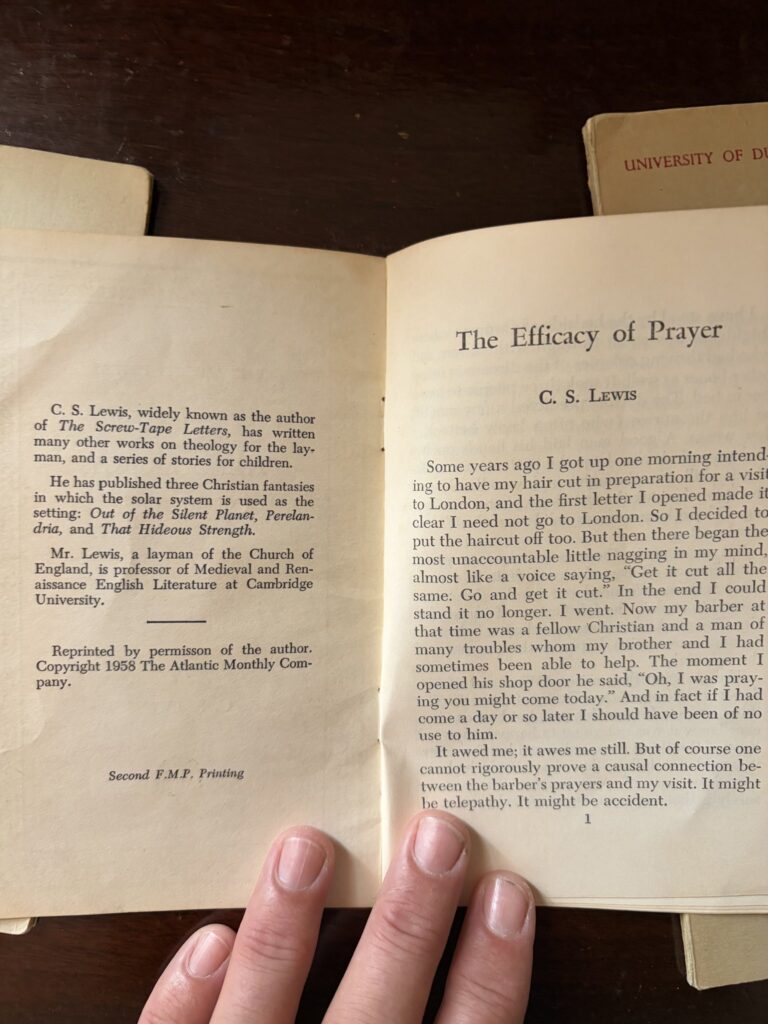
Forward Movement, the Episcopal publisher based in Cincinnati, Ohio, reprinted the essay as a small pamphlet in its series The Advent Papers. It is a lovely piece of American Lewis history: the author’s note spells it “The Screw-Tape Letters” and still describes Lewis as a professor at Cambridge, a detail that suggests this printing was made while he was still alive.
This copy: Forward Movement Publications, “Second F.M.P. Printing,” stapled pamphlet in the original green-bordered wrappers with the Forward Movement seal. “Reprinted by permission of the author. Copyright 1958 The Atlantic Monthly Company.”
Why these belong together
Read side by side, these four pamphlets cover seventeen years of Lewis’s public voice: the Oxford don taking on the Shakespeare critics in 1942, the wartime apologist defending objective value in 1943, the new Cambridge professor describing the end of an age in 1954, and the mature Christian writer reflecting on prayer at the end of the decade. Each was made to be read once and passed on, which is why so few have survived.
Why I’m sharing it
I have used these essays in my teaching for years, and holding them in their original form has always felt different from reading them in an anthology. I’d love for them to go to someone who will keep them together and enjoy the stories behind them as much as I have.
- Hamlet: The Prince or the Poem?, Humphrey Milford for the British Academy, 1942, in library binding, signed by a former owner
- The Abolition of Man, Geoffrey Bles, 1956 printing, original printed wrappers
- De Descriptione Temporum, Cambridge University Press, original printed wrappers
- The Efficacy of Prayer, Forward Movement Publications, The Advent Papers, second printing
How to bid
These four books will be sold together as a single lot by silent bid.
- Email your bid to daniel@theolatte.com with the subject line “Bid: Signed C.S. Lewis Letter.”
- Include your name, your bid in U.S. dollars, and the best way to reach you.
- If your bid is close to what I’m looking for, I’ll follow up with you personally.
- You can view my ebay seller ratings and my etsy shop ratings/reviews to check on my standard of business. I’ve got good reviews and I want to make sure you are pleased.
- If your bid is accepted, you’ll send your payment through Venmo.
- If requested, and you send an acceptable bid, I can do a video call for you to better inspect your item before sending payment.
- After I receive your payment, I will send the item first class with sufficient insurance to cover the value and send you the tracking number.
Please bid responsibly. I won’t be haggling much over price, so send your best offer the first time. The bid you send is the one I’ll consider. If it is close, I’ll either send a notice of acceptance with directions for next steps, or a counter offer. If you don’t hear back within a few days, feel free to send a higher bid.

