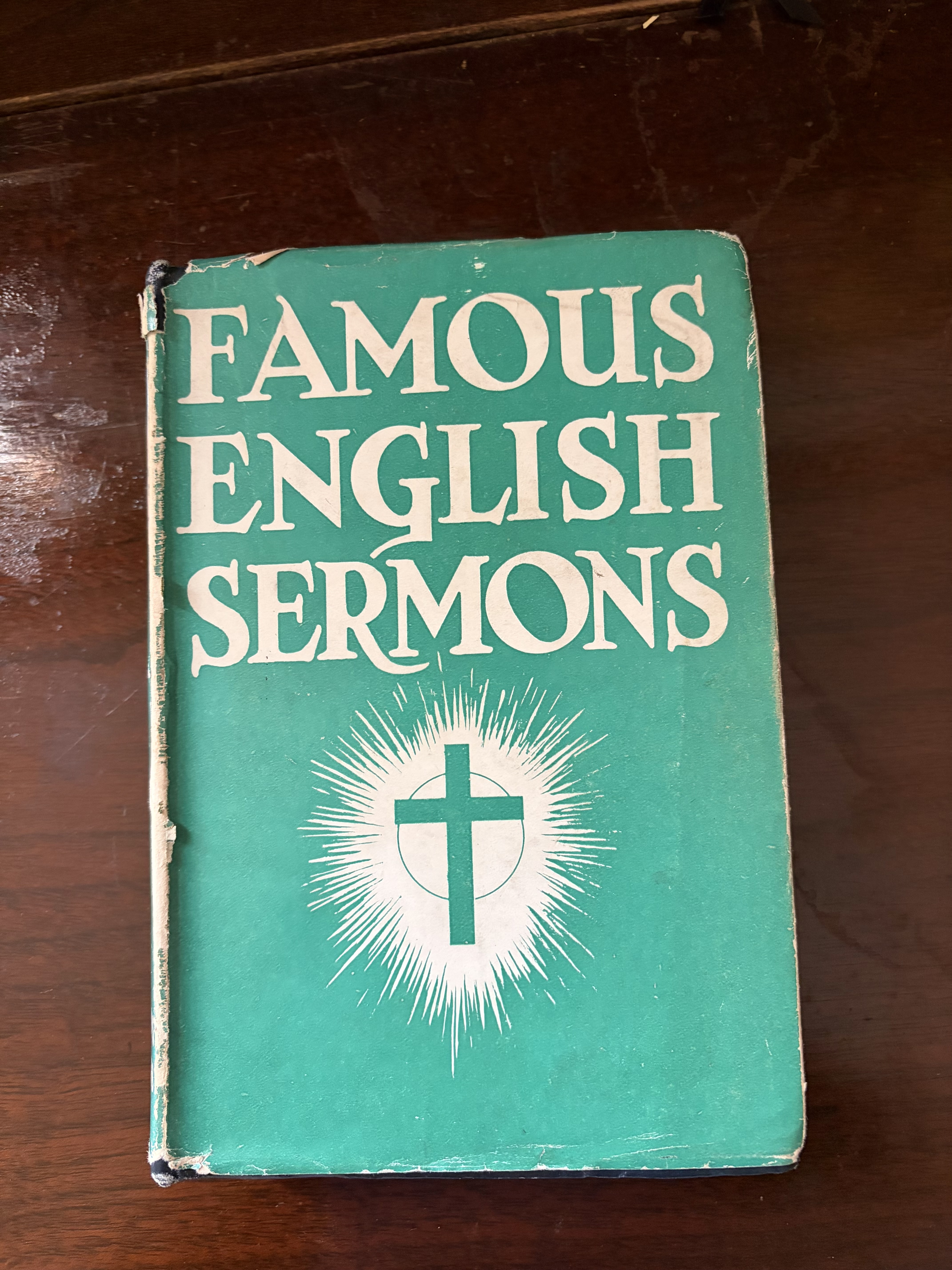
Bede, Latimer, Donne, Wesley, Newman, Spurgeon… and, on the very last page, a forty-year-old Oxford don who had preached his very first sermon only months before.
On the evening of Sunday, 22 October 1939, seven weeks after Britain declared war on Germany, C.S. Lewis climbed into the pulpit of the University Church of St Mary the Virgin in Oxford. It was the first sermon he ever preached. The pews were full of undergraduates who had every reason to wonder why they should keep reading Chaucer and doing chemistry problems while the country armed itself for war.
Lewis’s answer is the piece we now know as “Learning in War-Time.” Almost nobody knows that its first appearance between hard covers was in this book, under a different title: “The Christian in Danger.”
The sermon with three names
Few pieces by Lewis have had a more tangled life in print. On the night he preached it, the sermon was called “None Other Gods: Culture in War-Time,” and copies were printed for the people in the pews. Before the end of 1939 the Student Christian Movement reissued it as a pamphlet titled The Christian in Danger. In 1940 it was chosen for Famous English Sermons under that same title. Only in 1949, when it was collected in Transposition and Other Addresses (published in America as The Weight of Glory), did it become “Learning in War-Time,” the name it has carried ever since.
So the essay countless students and scholars have been handed has been hiding in plain sight in this anthology for more than eighty years, under a title most Lewis readers have never heard.
The sermon itself is Lewis at his clearest. War, he argued, doesn’t create a new situation. It only makes the permanent human situation impossible to ignore. “Life has never been normal,” he told the students. Men have always pursued learning and beauty on the edge of a precipice. And there was a sharper reason for Christian scholars to keep working: “Good philosophy must exist, if for no other reason, because bad philosophy needs to be answered.”
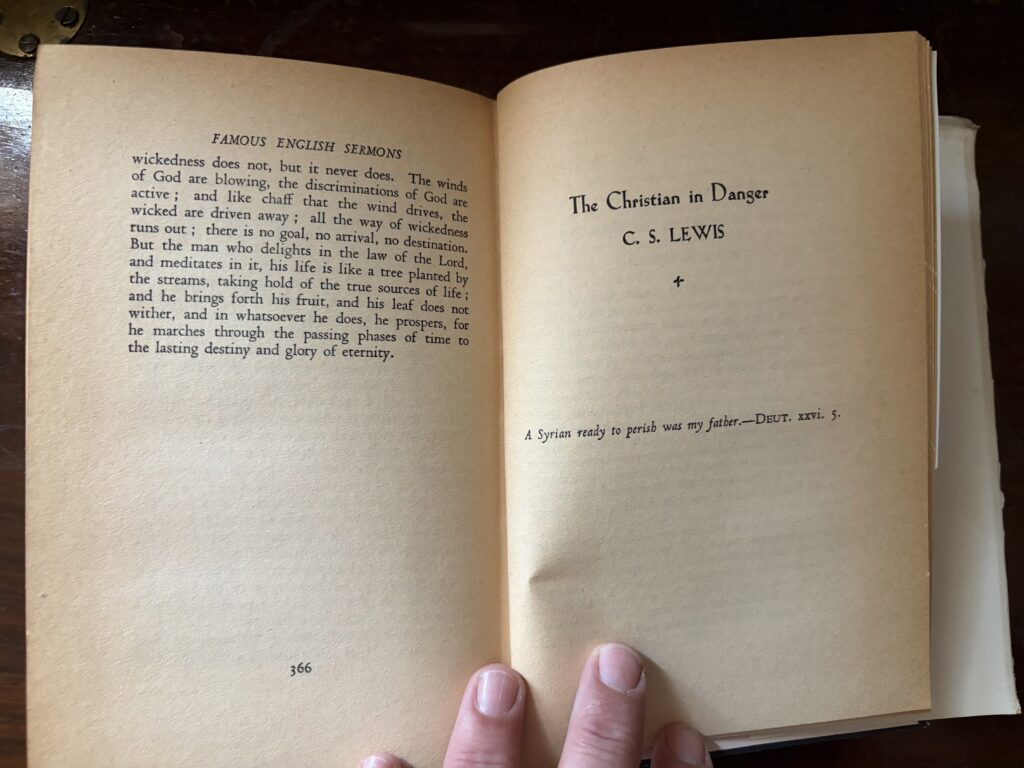
In this printing the sermon is headed by its text, Deuteronomy 26:5: “A Syrian ready to perish was my father.”
“Save the mark!” Lewis among the giants
In 1940 Lewis wrote to his brother Warnie with the news that someone wanted to put “that St Mary’s sermon of mine” into a collection of famous sermons. He was pleased, and a little alarmed. He would be printed alongside Bede, Latimer and Donne, and he joked that he hoped there would be a few “19th century duds” between them and him to soften the comparison.
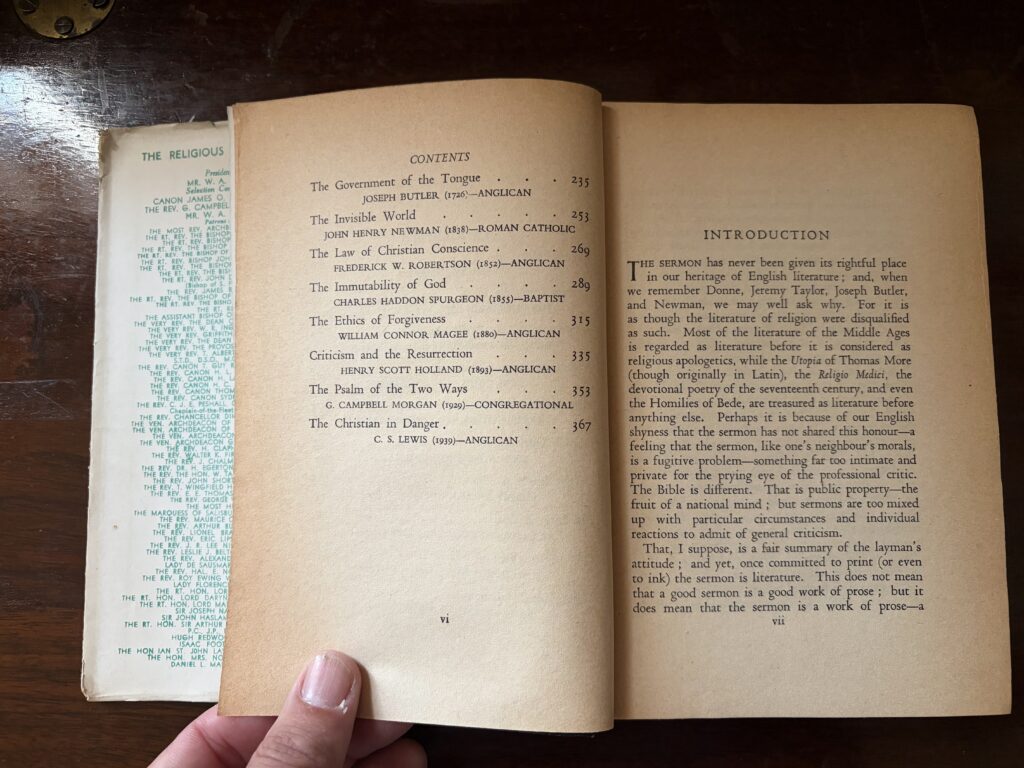
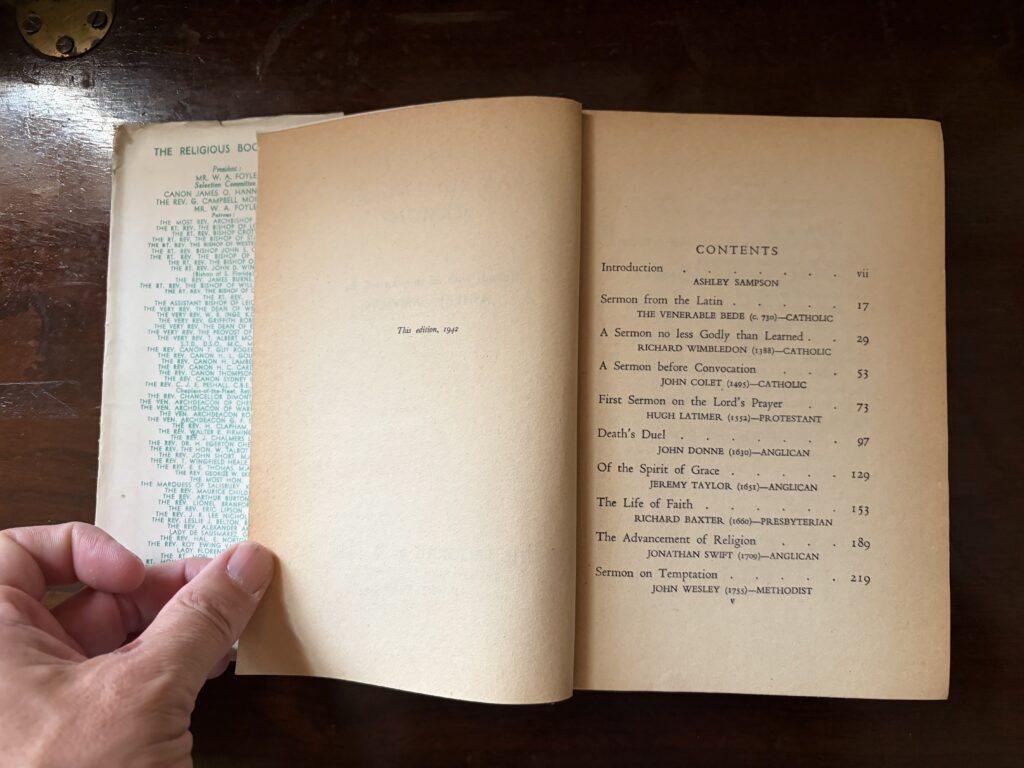
Open the contents page and you’ll see he got his wish. Newman, Robertson, Spurgeon, Magee, Holland and G. Campbell Morgan all stand between Donne and Lewis, who closes the book on page 367.
Keep in mind how little known Lewis was then. The Screwtape Letters hadn’t yet appeared, and the BBC broadcasts that became Mere Christianity hadn’t begun. This anthology placed him in the line of England’s great preachers before most of England knew his name.
The editor who launched Lewis as an apologist
The man who chose the sermon matters too. Ashley Sampson, the editor of this volume, was the publisher at the Centenary Press who had asked Lewis to write a book on suffering for his “Christian Challenge” series. That book was The Problem of Pain (1940), Lewis’s first full work of Christian apologetics. Sampson’s introduction here argues that the sermon has never been given its rightful place in English literature, and it names Donne, Jeremy Taylor, Joseph Butler and Newman as proof. Lewis himself would soon go on to prove his point.
Twelve centuries in one volume
The rest of the book is worth the price of admission on its own. A few of the stories inside:
- The Venerable Bede (c. 730). The book opens with a sermon from the Latin by the father of English history, a full twelve centuries before Lewis.
- Richard Wimbledon (1388). His sermon at Paul’s Cross was one of the most popular sermons of medieval England, and it was still being printed and read under the Tudors, more than 150 years later.
- Hugh Latimer (1552). Three years after preaching on the Lord’s Prayer, Latimer was burned at the stake in Oxford, a short walk from where Lewis would preach. “Be of good comfort, Master Ridley, and play the man,” he said at the stake.
- John Donne, “Death’s Duel.” Donne preached it before King Charles I, gaunt and dying, weeks before his own death. The court called it his own funeral sermon. Afterward he posed wrapped in his shroud for the portrait that became his monument in St Paul’s.
- Jonathan Swift (1709). Yes, the author of Gulliver’s Travels. Swift was a clergyman and later became Dean of St Patrick’s in Dublin.
- John Wesley (1755) and Charles Haddon Spurgeon (1855). “The Immutability of God” is the sermon Spurgeon preached at New Park Street in January 1855, when he was just twenty years old.
- John Henry Newman (1838). Newman was vicar of St Mary the Virgin, the same pulpit Lewis preached from a century later. The two sermons share a binding and a pulpit.
A book chosen by a book club, with a few surprises on the jacket
Famous English Sermons was first published by Thomas Nelson in 1940. This copy is the 1942 edition (“This edition, 1942” on the verso), issued for The Religious Book Club, run by Foyles, the famous London bookshop, with W.A. Foyle as its president. The front flap lists the club’s officers and patrons, a roll call of wartime bishops, deans, and peers.
Look closely at the Selection Committee and you’ll find two surprises. One is the Rev. G. Campbell Morgan, which means one of the men choosing the club’s books has his own sermon in this one. The other is Canon James O. Hannay, who was better known to readers of comic novels as “George A. Birmingham.”
Condition
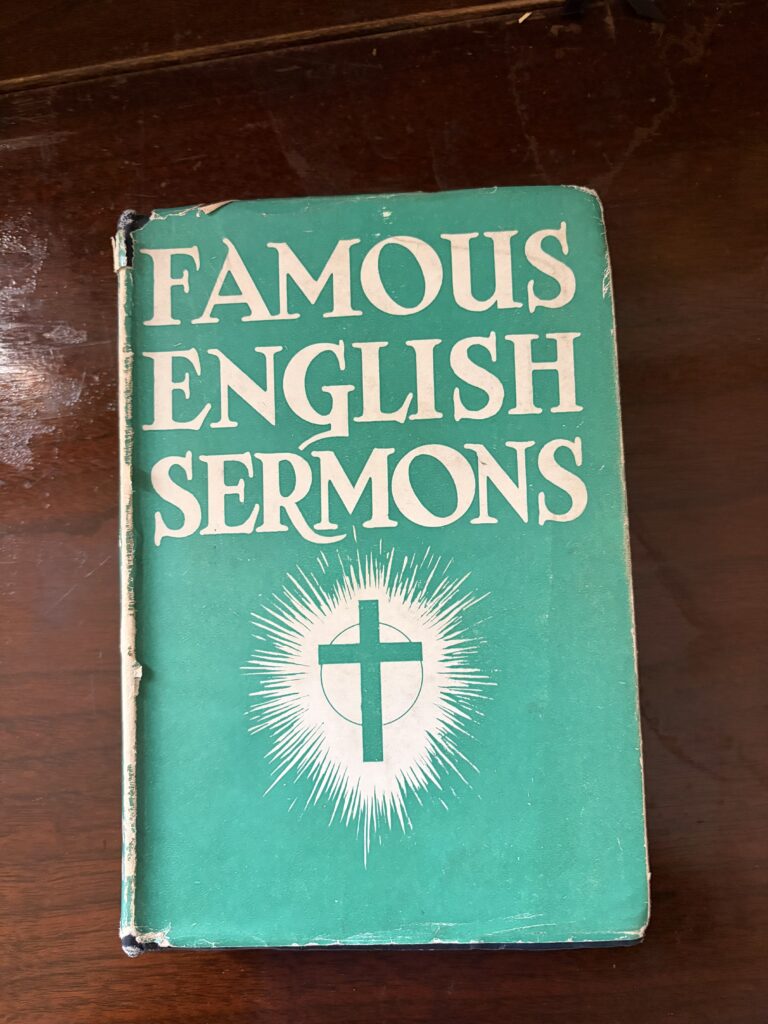
Dark blue cloth in the original printed dust jacket, green with white lettering and a radiant cross. The jacket shows edge wear and chipping, with small losses at the head of the spine and along the top edge near the spine. The spine panel is toned and rubbed. The pages are evenly toned, as is typical of wartime paper, and the text is clean and complete through Lewis’s sermon at the end of the book. Fragile wartime jackets like this one often didn’t survive.
Why I’m sharing it
Most Lewis collectors know “Learning in War-Time.” Very few know it went out into the world as “The Christian in Danger,” bound alongside Donne and Spurgeon in a book chosen by a wartime religious book club. This is the earliest form in which most readers could have kept it on a shelf, and I’d love for it to go to someone who will enjoy that story as much as I have.
- Famous English Sermons, ed. Ashley Sampson, Religious Book Club edition, 1942
- Includes C.S. Lewis, “The Christian in Danger” (later “Learning in War-Time”)
- Original printed dust jacket
- Free shipping within the U.S.
How to bid
This book will be sold by silent bid.
- Email your bid to daniel@theolatte.com with the subject line “Bid: Signed C.S. Lewis Letter.”
- Include your name, your bid in U.S. dollars, and the best way to reach you.
- If your bid is close to what I’m looking for, I’ll follow up with you personally.
- You can view my ebay seller ratings and my etsy shop ratings/reviews to check on my standard of business. I’ve got good reviews and I want to make sure you are pleased.
- If your bid is accepted, you’ll send your payment through Venmo.
- If requested, and you send an acceptable bid, I can do a video call for you to better inspect your item before sending payment.
- After I receive your payment, I will send the item first class with sufficient insurance to cover the value and send you the tracking number.
Please bid responsibly. I won’t be haggling much over price, so send your best offer the first time. The bid you send is the one I’ll consider. If it is close, I’ll either send a notice of acceptance with directions for next steps, or a counter offer. If you don’t hear back within a few days, feel free to send a higher bid.

