One sermon, three printings, and a front-row seat to how a few pages preached in wartime Oxford became one of the most loved pieces of Christian writing of the last century.
On the evening of Sunday, 8 June 1941, C.S. Lewis climbed into the pulpit of the University Church of St Mary the Virgin in Oxford to preach at Evensong. Britain had just come through the worst months of the Blitz. Every seat was taken. Students sat in the aisles and perched in the window ledges, and still more people gathered outside. Walter Hooper later described it as one of the largest congregations the church had seen in modern times.
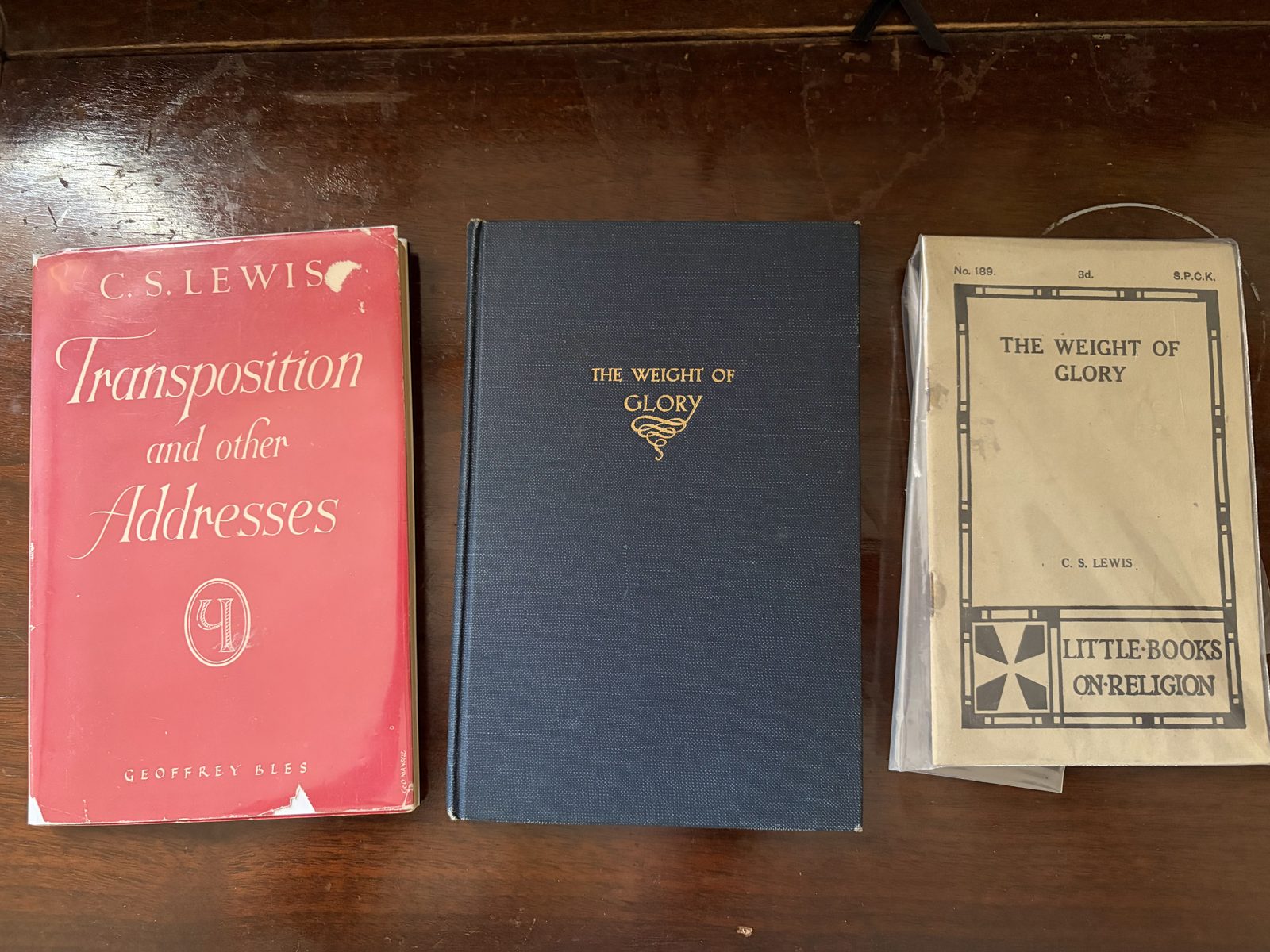
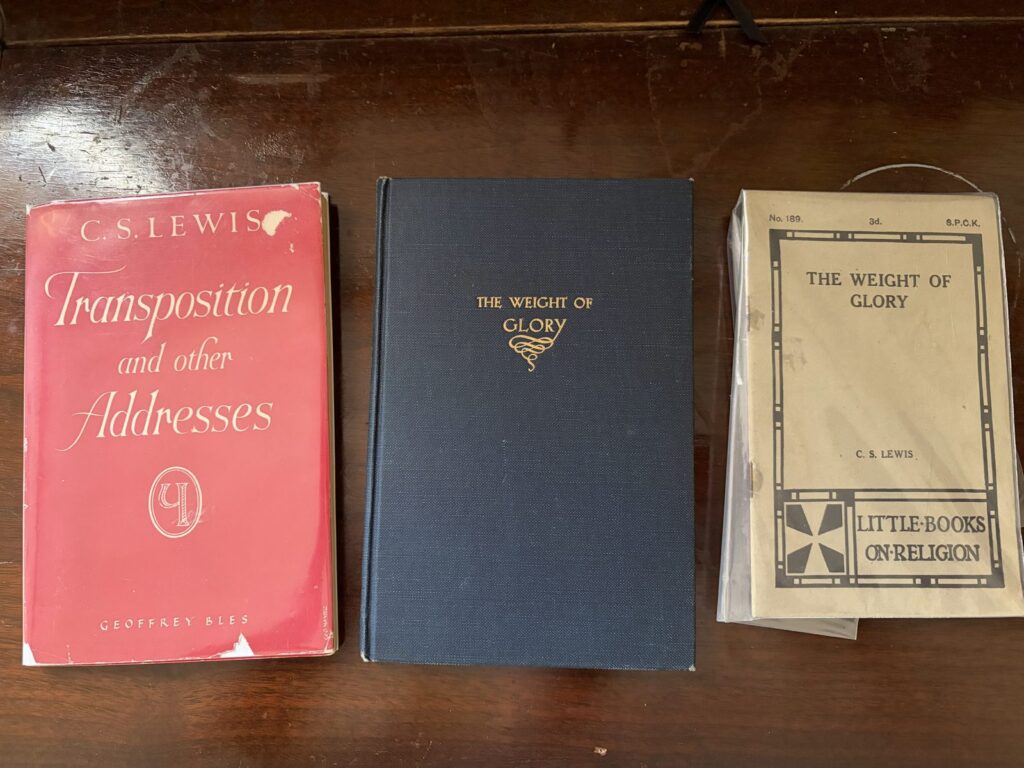
What Lewis gave them that night was “The Weight of Glory.” This lot follows that sermon through its first three lives in print.
The sermon that started with desire
Lewis opened with a surprise. Ask twenty good people to name the highest virtue, he said, and most would answer “Unselfishness.” Ask the great Christians of old, and they would have said “Love.” From there he argued that our longing for joy is not something to be ashamed of. Our problem is that our desires are too weak, not too strong. We are like a child happily making mud pies in a slum because he cannot imagine what is meant by the offer of a holiday at the sea.
Then he turned the whole thing toward the people sitting in front of him, and gave us the line that has been quoted ever since: “There are no ordinary people. You have never talked to a mere mortal.”
Decades later, a young John Piper picked up a cheap paperback of the sermon. He said its first page became one of the most influential things he ever read, and it set him on the road to writing Desiring God. Walter Hooper thought it good enough to sit beside the Church Fathers.
1. The 1942 SPCK pamphlet: how it first reached readers
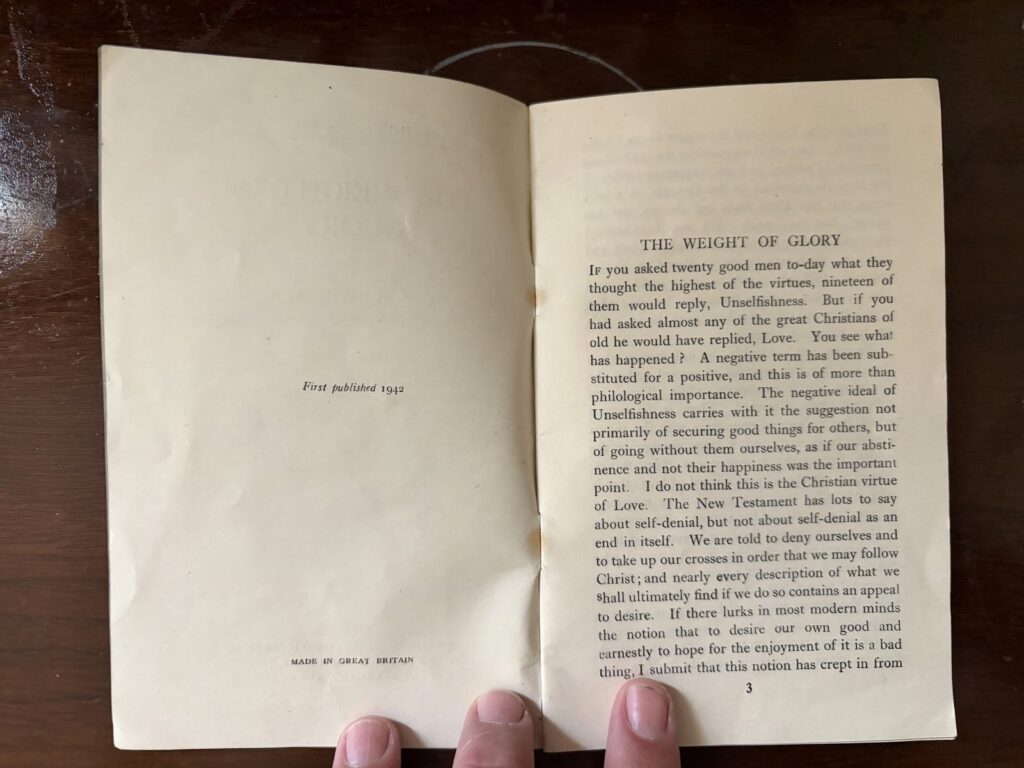
The sermon first appeared in the journal Theology in November 1941. The Society for Promoting Christian Knowledge, which published that journal, then issued it on its own as No. 189 in its “Little Books on Religion” series, priced at just threepence. You can see “No. 189,” “3d.,” and “S.P.C.K.” printed right across the top of the cover.
This is the form in which wartime readers first carried “The Weight of Glory” home: a slim booklet in a printed paper wrapper. The verso reads “First published 1942” and “Made in Great Britain.” Little paper pamphlets like this were cheap, easy to lose, and meant to be passed around, so surviving copies are much harder to find than the later hardcovers.
Condition: original printed wrappers, with age toning and a few spots of foxing along the gutter. It has been kept in a protective sleeve.
2. Transposition and Other Addresses (Geoffrey Bles, London, 1949): the British first edition
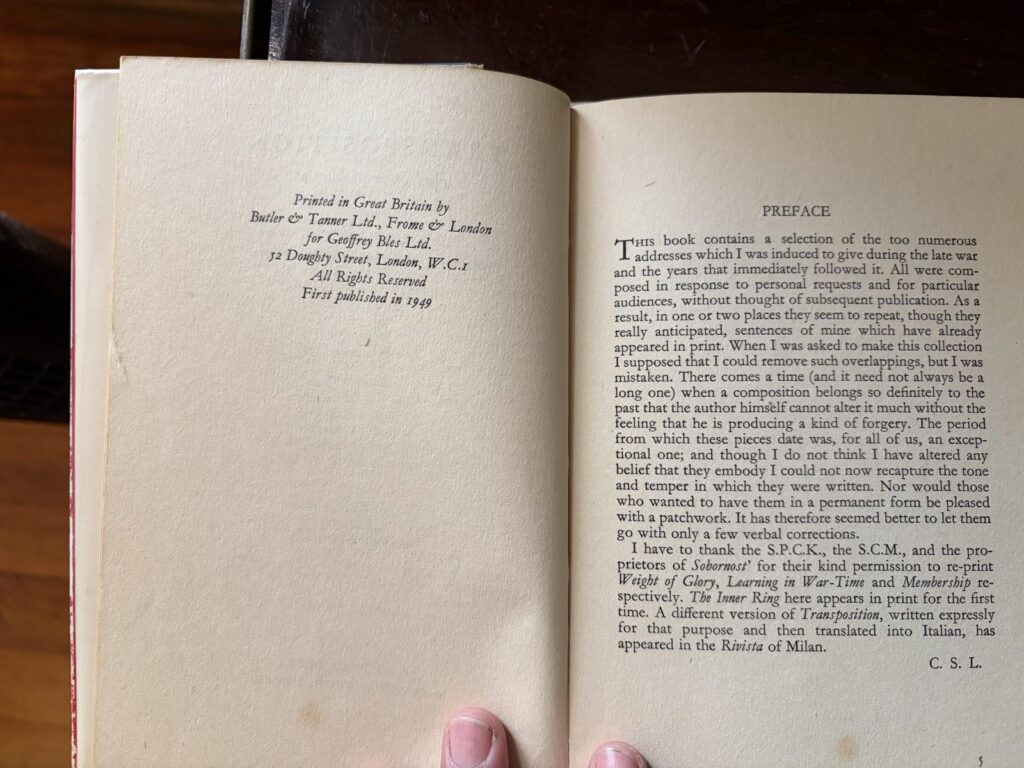
In 1949 Lewis’s London publisher, Geoffrey Bles, gathered “The Weight of Glory” with four other wartime addresses into a single book. Oddly, Bles didn’t name the book after the famous sermon. They named it after another address, Transposition.
That choice comes with a story. Lewis first preached “Transposition” on Whit Sunday 1944 in the chapel of Mansfield College, Oxford. Partway through, he was so overcome with emotion that he stopped, apologized, and stepped out of the pulpit. The congregation sang a hymn while he collected himself, and then he came back and finished the sermon.
This book is also the first appearance in print of “The Inner Ring,” Lewis’s famous address on the pull of belonging to the in-crowd. He gave it as the Commemoration Oration at King’s College, London, in December 1944. Lewis says so in his preface, opposite the imprint page shown here, which reads “First published in 1949.”
Condition: Original red dust jacket with chipping at the upper right corner and lower edge, and some edge wear. The jacket artist’s signature is along the lower edge.
3. The Weight of Glory and Other Addresses (Macmillan, New York, 1949): the American first printing
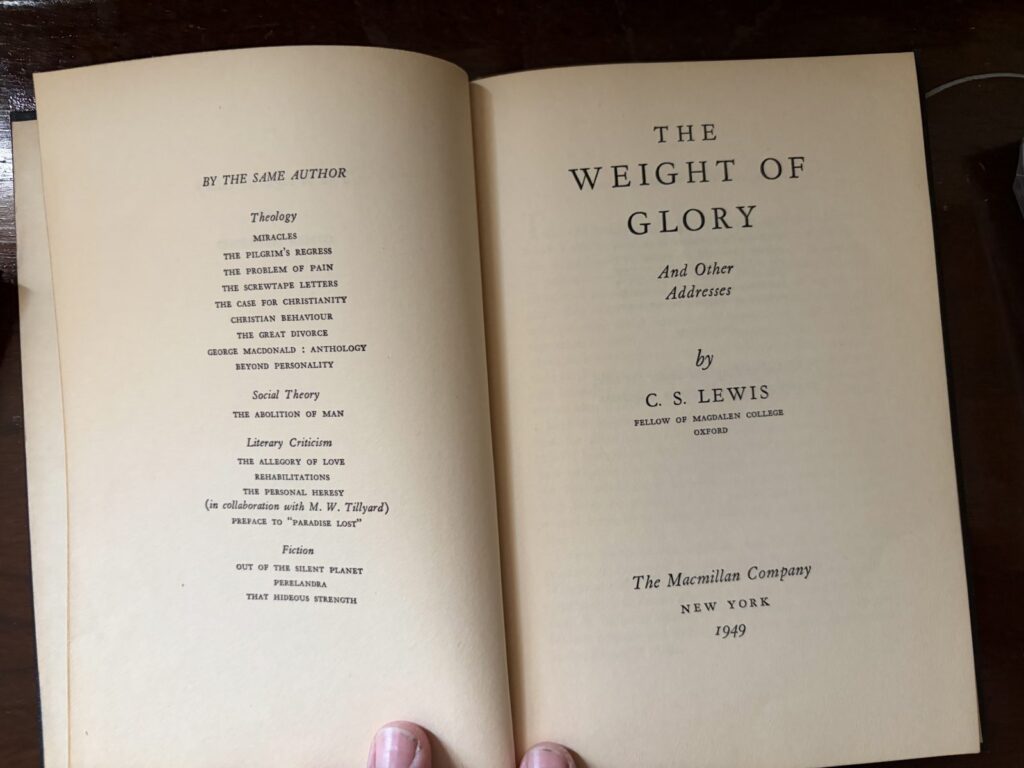
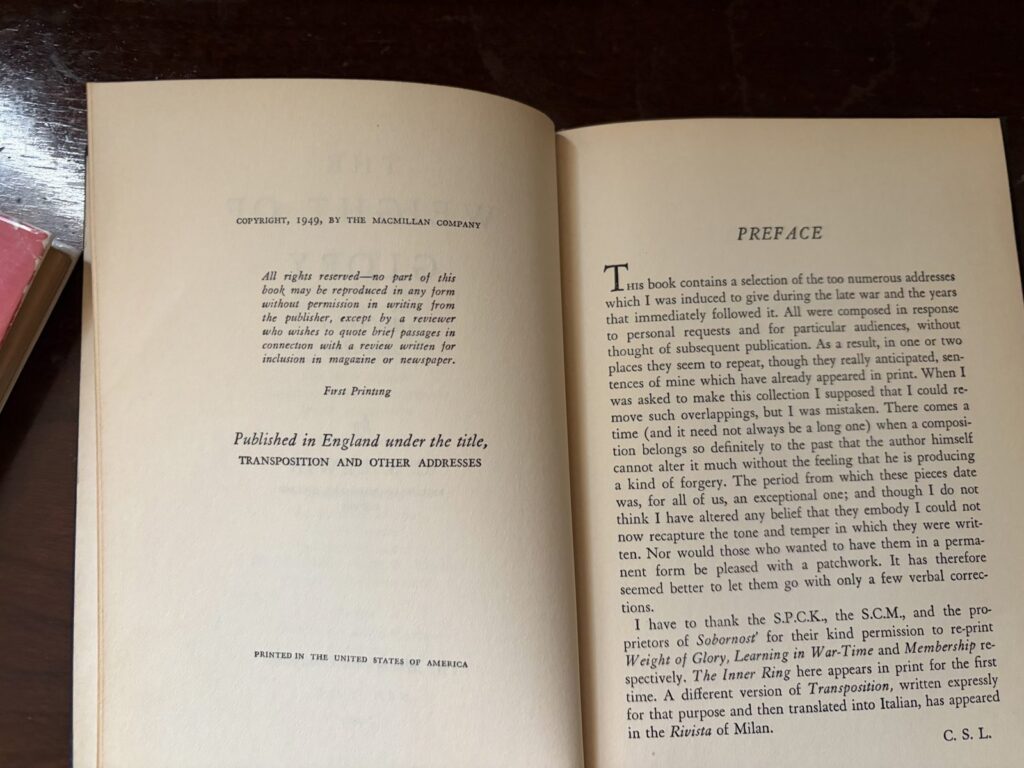
This copy is clearly marked “First Printing” on the copyright page, right above the line “Published in England under the title, Transposition and Other Addresses.” The title page names Lewis as “Fellow of Magdalen College, Oxford.” The facing page lists his books to date, from The Screwtape Letters to That Hideous Strength, a snapshot of Lewis just before Narnia. The Lion, the Witch and the Wardrobe came out the following year.
Condition: Navy cloth with gilt titling and flourish on the front board. There’s light wear at the corners and spine ends. No dust jacket.
Why these three belong together
Put them side by side and you can watch a sermon become a classic. First comes a threepenny pamphlet printed in wartime. Then the British edition, named after a different address. Then the American edition, which finally gave the sermon its name on the spine. Both books carry the same short preface, set in two different typefaces. In it Lewis explains why he left these wartime addresses almost exactly as he first gave them: to change them now, he said, would feel like a kind of forgery.
For a Lewis collector, this is a rare chance to own the whole story of a single piece in one lot.
Why I’m sharing it
“The Weight of Glory” is one of the pieces of writing that has shaped me most, and tracking down these three printings has been a joy. I’d love for them to go to someone who will keep them together and treasure the story they tell as much as I have. They would make a wonderful addition to any collection of Lewis, the Inklings, or 20th-century Christian writing.
- 1942 SPCK “Little Books on Religion” No. 189 pamphlet
- 1949 Geoffrey Bles Transposition and Other Addresses, UK first edition, in dust jacket
- 1949 Macmillan The Weight of Glory and Other Addresses, US first edition, stated First Printing
- Sold together as one lot
- Free shipping within the U.S.
How to bid
These three pieces will be sold together as a single lot by silent bid.
- Email your bid to daniel@theolatte.com with the subject line “Bid: The Weight of Glory.”
- Include your name, your bid in U.S. dollars, and the best way to reach you.
- If your bid is close to what I’m looking for, I’ll follow up with you personally.
- You can view my ebay seller ratings and my etsy shop ratings/reviews to check on my standard of business. I’ve got good reviews and I want to make sure you are pleased.
- If your bid is accepted, you’ll send your payment through Venmo.
- If requested, and you send an acceptable bid, I can do a video call for you to better inspect your item before sending payment.
- After I receive your payment, I will send the item first class with sufficient insurance to cover the value and send you the tracking number.
Please bid responsibly. I won’t be haggling much over price, so send your best offer the first time. The bid you send is the one I’ll consider. If it is close, I’ll either send a notice of acceptance with directions for next steps, or a counter offer. If you don’t hear back within a few days, feel free to send a higher bid.

