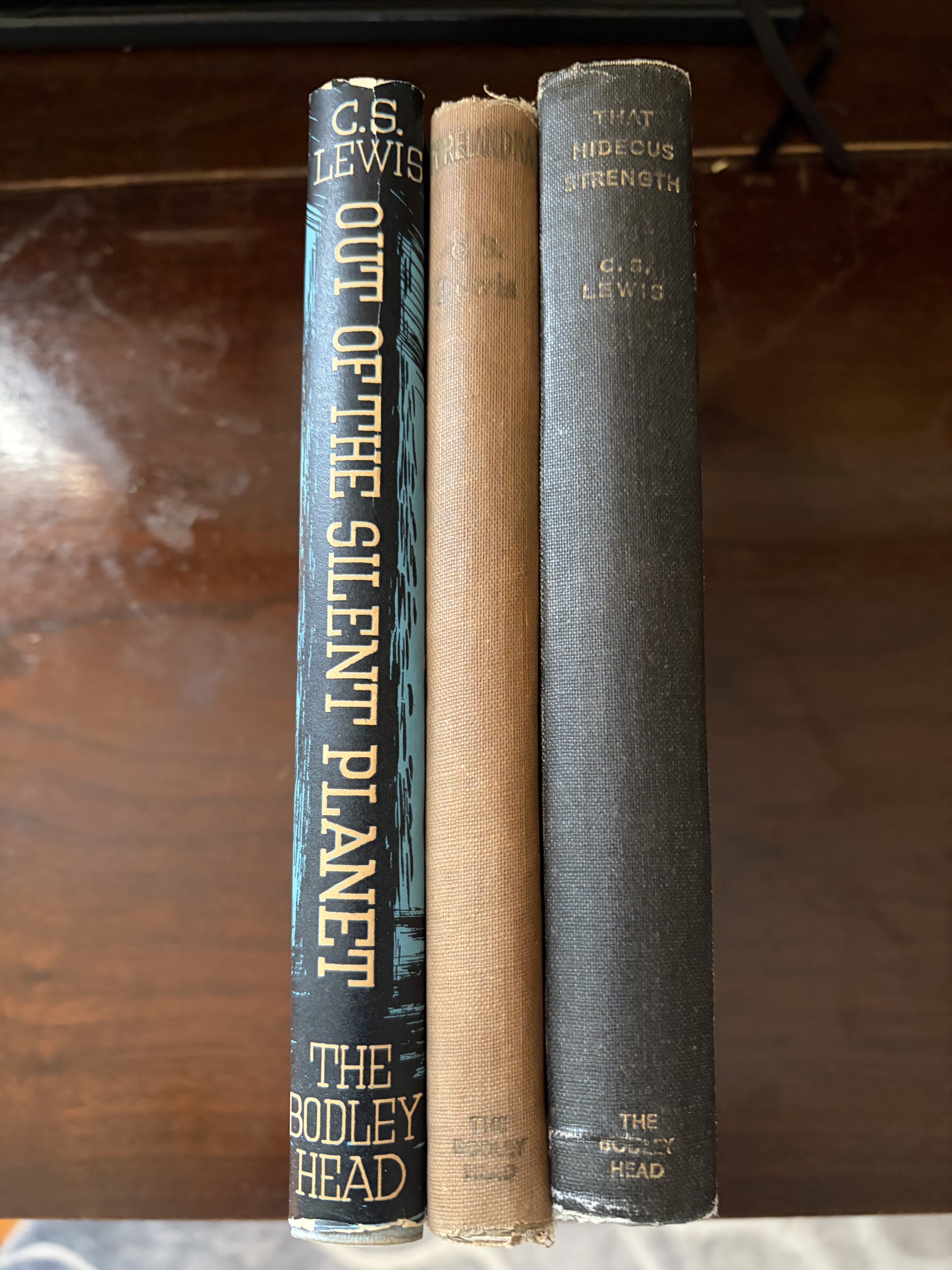
A coin toss between two friends, a dedication to a community of nuns, a review by George Orwell, and a manuscript said to have been rescued from a bonfire. These are C.S. Lewis’s Ransom books, in early Bodley Head printings, along with the first edition of the most argued-over story Lewis ever wrote.
Before Narnia, before Mere Christianity, C.S. Lewis was a science-fiction writer. His three novels about the philologist Elwin Ransom took readers to Mars, to Venus, and finally to a sleepy English college town where the powers of heaven and hell come to earth. This lot brings together three Bodley Head printings of the trilogy, including a true first edition of That Hideous Strength (1945), with the 1977 first edition of The Dark Tower and Other Stories.
It started with a coin toss
Around 1936, Lewis and J.R.R. Tolkien agreed that there weren’t enough of the kind of stories they liked to read, so each would write one. Lewis would take a journey through space and Tolkien a journey through time. According to the story, they tossed a coin to decide. Tolkien’s time-travel book was never finished. Lewis’s became Out of the Silent Planet, and its hero, Ransom, is a philologist believed to be modeled partly on Tolkien himself.
1. Out of the Silent Planet (The Bodley Head, 1951 printing)
Lewis was provoked into writing it. He had read Olaf Stapledon’s Last and First Men and an essay by the biologist J.B.S. Haldane. Both took space travel seriously, and both, as Lewis saw it, imagined humanity spreading across the universe at any cost. So he wrote a story where the humans are the menace and the “aliens” are innocent.
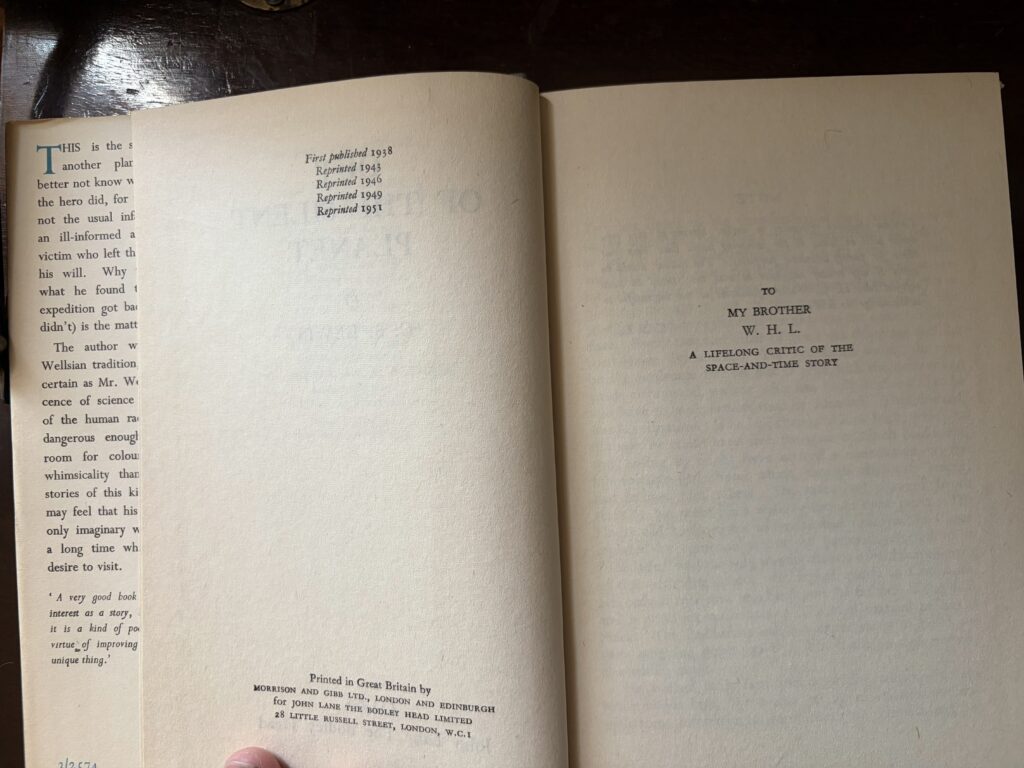
The dedication is a private joke: “To my brother W.H.L., a lifelong critic of the space-and-time story.”
The book was more subversive than its first readers realized. In 1939 Lewis wrote to Sister Penelope, an Anglican nun at Wantage, that out of about sixty reviews, only two had noticed that his “Bent One” was the Christian story of the fall. Any amount of theology, he joked, could now be smuggled into people’s minds under cover of romance.
This copy: The Bodley Head, 1951 (first published 1938, reprinted 1943, 1946, 1949 and 1951), in its original dust jacket. The striking blue and black jacket shows a planet over a dark sea, and the front flap compares the author to H.G. Wells. The jacket has chipping at the head and foot of the spine and wear along the folds.
2. Perelandra (The Bodley Head, 1944 printing)
Ransom goes to Venus, a world of floating islands, golden seas and a newly created Eve, and he has to stop her from falling the way ours did. Lewis said the whole book began with a single mental picture of those floating islands.
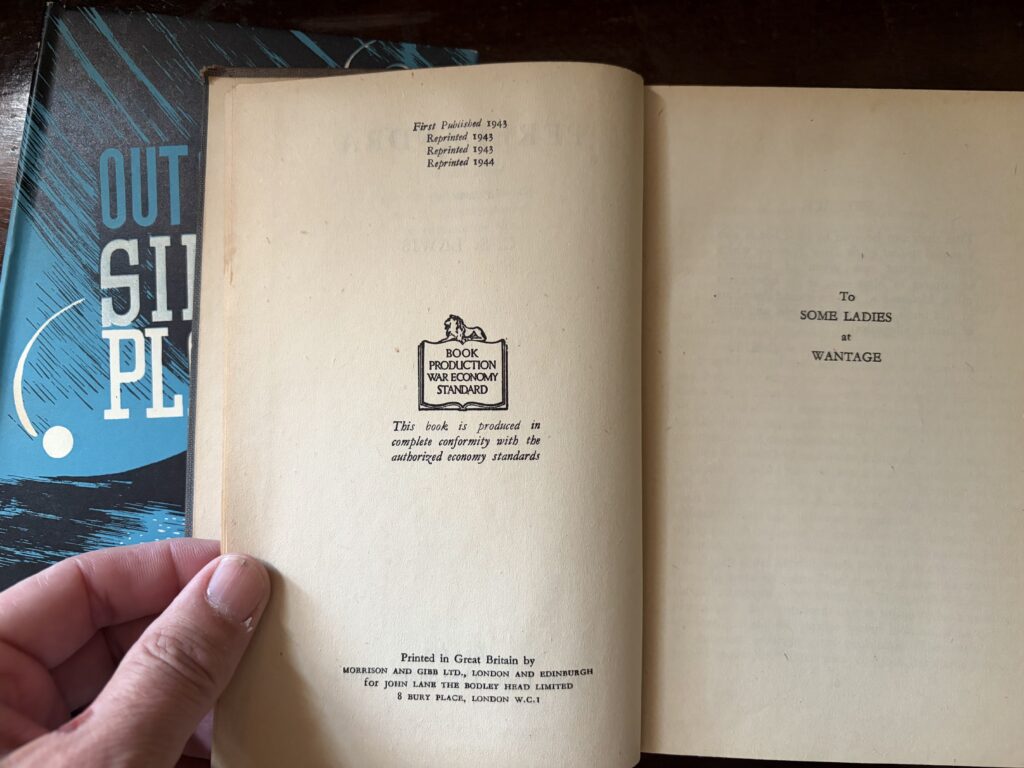
Look at the dedication: “To some ladies at Wantage.” They were the Anglican Community of St Mary the Virgin at Wantage, home of Sister Penelope, the same nun to whom Lewis had confided his plan to smuggle theology into fiction. Lewis is often said to have counted Perelandra among his favorites of all his books.
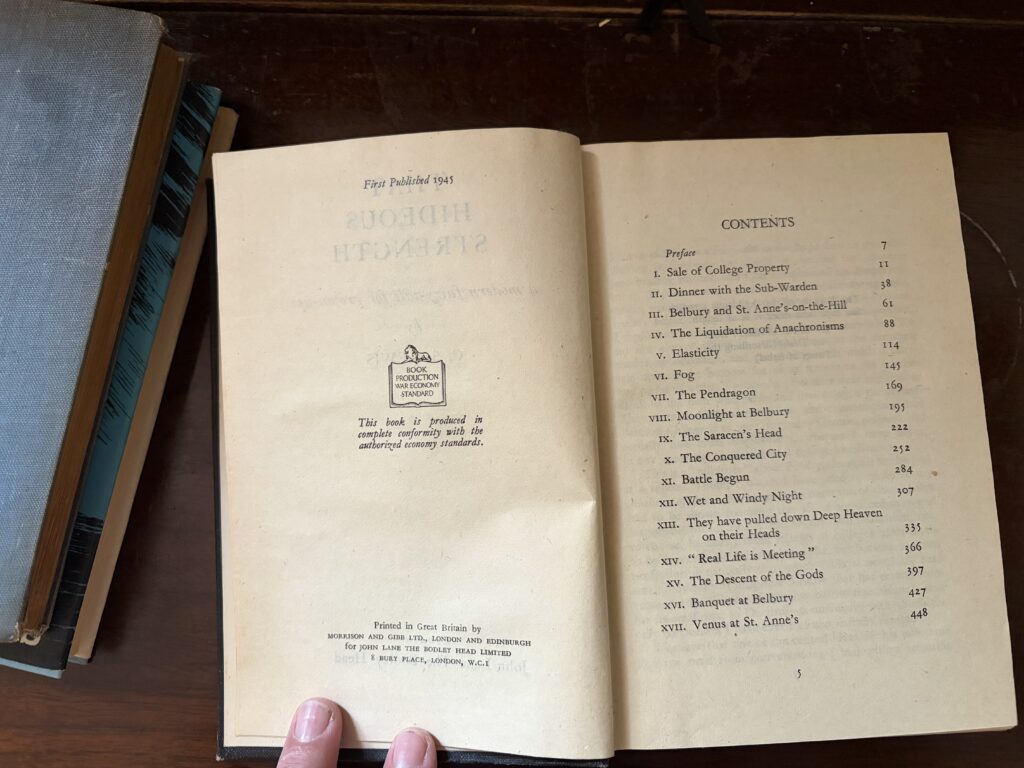
This copy: The Bodley Head, 1944 (first published 1943, reprinted twice in 1943 and again in 1944). Four printings in about a year, in the middle of wartime paper rationing, tell you how quickly readers took to it. The verso carries the lion-and-book emblem of the Book Production War Economy Standard, the rules that forced British publishers to use thinner paper and tighter margins. Brown cloth, no dust jacket. The spine is sunned and rubbed with fraying at the head and foot.
3. That Hideous Strength (The Bodley Head, 1945): first edition
The last book comes home to England. A sinister institute called N.I.C.E. moves into a small university town, Merlin wakes from a centuries-long sleep, and Ransom leads a small household against them. Lewis called it “a modern fairy-tale for grown-ups.” In his preface he explains that the story makes the same serious point as his short book The Abolition of Man.
The title comes from a 16th-century Scottish poem by Sir David Lyndsay describing the Tower of Babel: “The shadow of that hyddeous strength / Sax myle and more it is of length.”
George Orwell reviewed it in August 1945 under the headline “The Scientist Takes Over.” He thought the novel would have been stronger without its angels and Merlin, but he still called it worth reading.
This copy: First edition, The Bodley Head, 1945, with “First Published 1945” on the verso and no later printings listed. It’s also a War Economy Standard book. Dark cloth with spine lettering, no dust jacket. The spine is rubbed with wear at the foot, and the pages are evenly toned.
4. The Dark Tower and Other Stories (Collins, 1977): first edition
This is where the story gets strange.
In 1977, fourteen years after Lewis’s death, his literary executor Walter Hooper published an unfinished novel that seemed to be a lost sequel to Out of the Silent Planet. In The Dark Tower, a group of Cambridge academics, Ransom among them, peer through a “chronoscope” into another time. There, a figure with a poisonous horn growing from his forehead stings people and turns them into mindless automatons who build him a dark tower. The tower looks uncannily like the new Cambridge University Library. The manuscript breaks off mid-story.
Hooper said he saved the manuscript in early 1964, when Lewis’s brother Warnie was burning his papers on a bonfire at the Kilns. Then the questions started. In 1988 the scholar Kathryn Lindskoog published The C.S. Lewis Hoax, arguing that The Dark Tower was a forgery. The fight went on for years, with handwriting, provenance, and even computer analyses of Lewis’s vocabulary entering the debate.
The most memorable piece of evidence came in 2003. The scholar Alastair Fowler recalled that in 1952 Lewis had shown him a manuscript about a “Stinging Man.” Many readers took that as strong support for the story being Lewis’s own, though skeptics noted it was a memory from half a century earlier. Whatever you conclude, this book is where the argument began.
The volume also collects Lewis’s other short fiction, including “Ministering Angels,” “The Shoddy Lands,” “Forms of Things Unknown” and the unfinished “After Ten Years.”
This copy: First edition, Collins, London, 1977, in dust jacket. Photos of this copy, including the jacket and copyright page, are available on request.
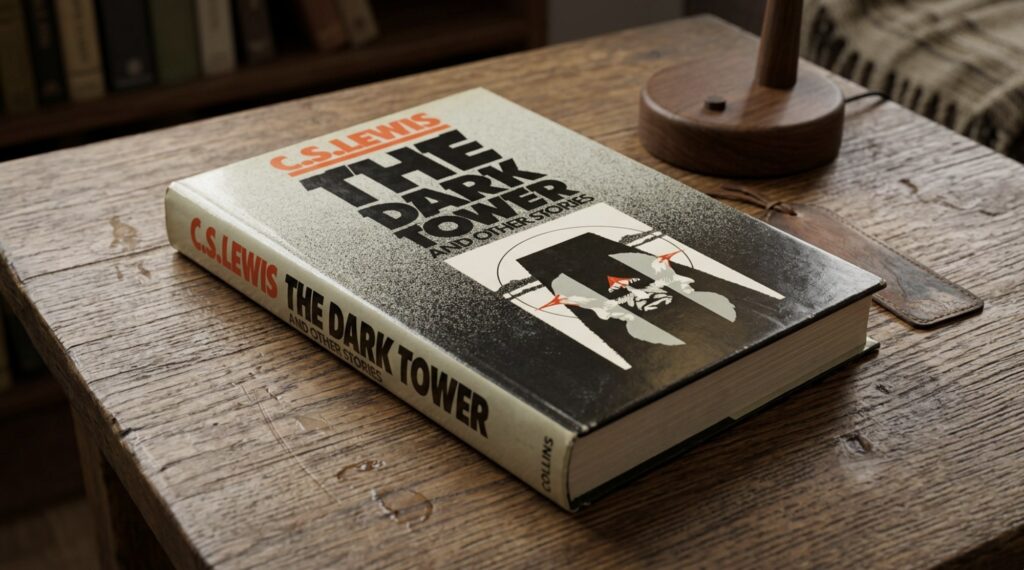
Illustration only: this image was generated with AI and is not a photograph of the copy offered here. I will update this with pictures of the real book soon.
Why these belong together
Read in order, these four books show Lewis’s whole adventure in science fiction: a wager with Tolkien, two wartime novels on rationed paper, a first edition published the summer the war ended, and a posthumous fragment that still has scholars arguing. Each Bodley Head copy shows the history of when it was made, from the War Economy emblem to the publisher’s change of address between printings.
Why I’m sharing it
These books show the most imaginative side of Lewis, and putting this set together has been a real pleasure. I’d love for it to go to someone who will keep the books together and enjoy the stories behind them as much as I have.
- Out of the Silent Planet, The Bodley Head, 1951 printing, in original dust jacket
- Perelandra, The Bodley Head, 1944 printing (War Economy Standard)
- That Hideous Strength, The Bodley Head, 1945, first edition (War Economy Standard)
- The Dark Tower and Other Stories, Collins, 1977, first edition, in dust jacket
- Sold together as one lot
- Free shipping within the U.S.
How to bid
These four books will be sold together as a single lot by silent bid.
- Email your bid to daniel@theolatte.com with the subject line “Bid: Signed C.S. Lewis Letter.”
- Include your name, your bid in U.S. dollars, and the best way to reach you.
- If your bid is close to what I’m looking for, I’ll follow up with you personally.
- You can view my ebay seller ratings and my etsy shop ratings/reviews to check on my standard of business. I’ve got good reviews and I want to make sure you are pleased.
- If your bid is accepted, you’ll send your payment through Venmo.
- If requested, and you send an acceptable bid, I can do a video call for you to better inspect your item before sending payment.
- After I receive your payment, I will send the item first class with sufficient insurance to cover the value and send you the tracking number.
Please bid responsibly. I won’t be haggling much over price, so send your best offer the first time. The bid you send is the one I’ll consider. If it is close, I’ll either send a notice of acceptance with directions for next steps, or a counter offer. If you don’t hear back within a few days, feel free to send a higher bid.

