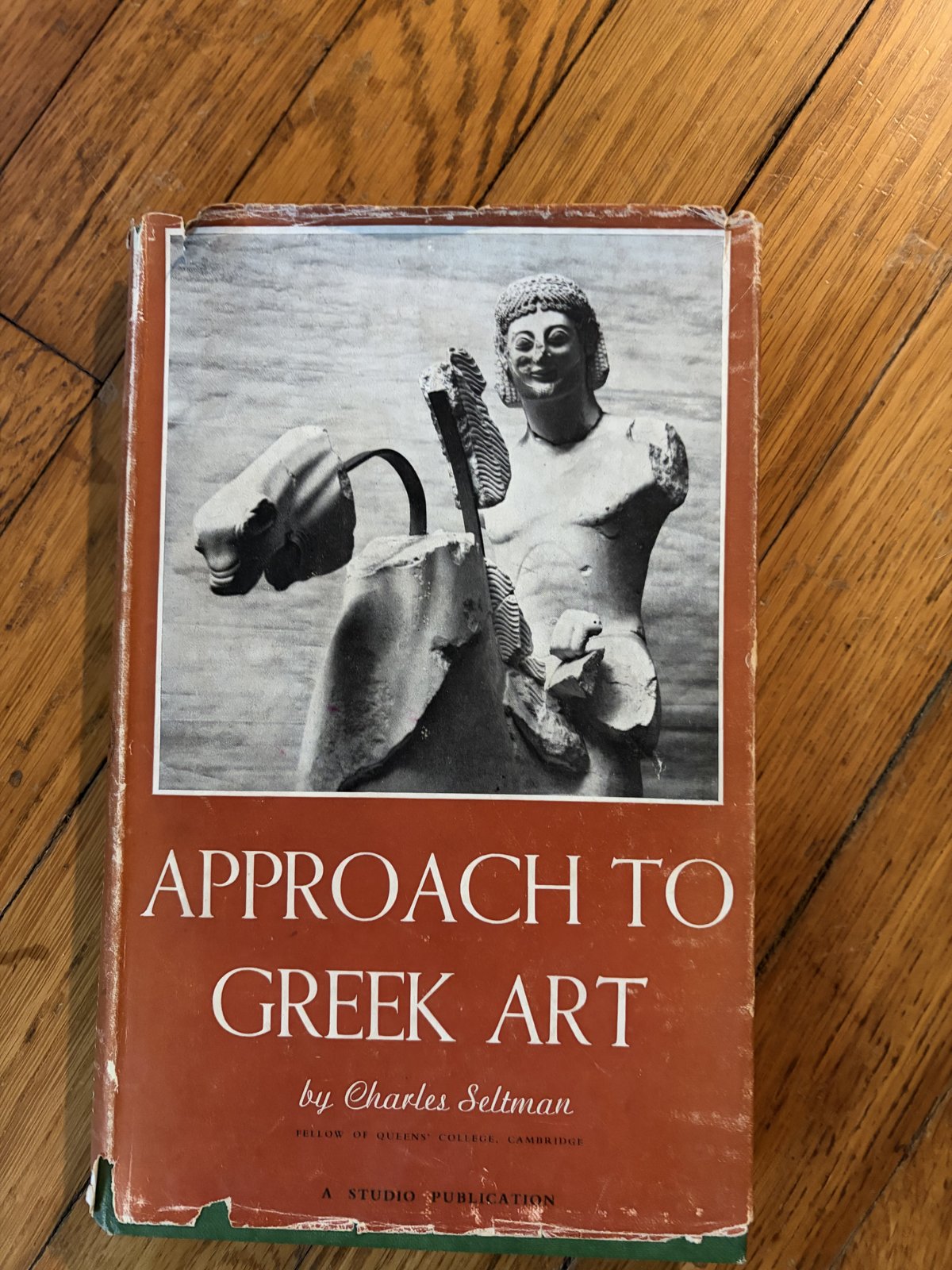
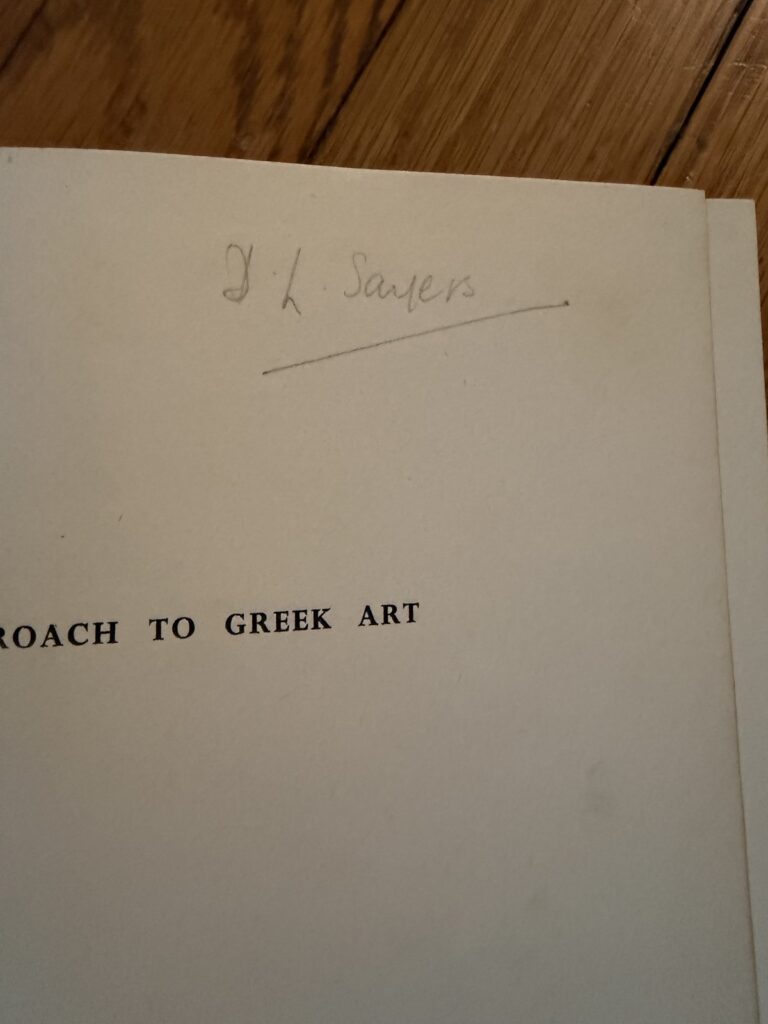
A pencil signature, a small white label, and a book on the Greeks. This copy of Charles Seltman’s Approach to Greek Art (1948) belonged to Dorothy L. Sayers. She signed it “D. L. Sayers” in pencil and drew a long line under her name. It stayed in her library until her personal books went up for auction at Sotheby’s in London more than forty years later.
Most collectors only get close to the Inklings’ circle through first editions. This is a book that one of them actually owned. Sayers was Lewis’s friend and correspondent, and she contributed to the Inklings’ own tribute volume. She held this book and wrote her name in it. It’s offered here by silent bid.
Who Was Dorothy L. Sayers?
Dorothy Leigh Sayers (1893–1957) was the only child of a clergyman, born in Oxford. She went to Somerville College, took first-class honours in modern languages, and in 1920 was among the first women ever awarded an Oxford degree. She then worked as an advertising copywriter in London, and her firm is credited with the phrase “It pays to advertise.” In her spare time she invented Lord Peter Wimsey.
The Wimsey novels, including Whose Body?, Strong Poison, Murder Must Advertise, The Nine Tailors and Gaudy Night, made her one of the great names of detective fiction’s Golden Age. She was a founding member of the Detection Club alongside G.K. Chesterton and Agatha Christie, and she later became its president.
In mid-career she changed course. Her radio play cycle on the life of Christ, The Man Born to Be King (1941–42), caused a national row when it first aired and then became a national treasure. In The Mind of the Maker (1941) she worked out a theology of creativity based on the Trinity. Her wartime essays, collected in Creed or Chaos?, argued that “the dogma is the drama.” She spent her last years translating Dante’s Divine Comedy for Penguin. She died in December 1957 with Paradiso still unfinished.
Sayers and the Inklings
Sayers wasn’t an official Inkling, as the Thursday-night group at Magdalen and the Tuesday mornings at the Eagle and Child were for men only. She was still very much part of the same world and a personal friend of Lewis.
Charles Williams was the friend who started her on Dante. She read his The Figure of Beatrice in 1944 and then read the Inferno in the original Italian during the air raids. Dante took over the rest of her working life. When Williams died suddenly in 1945, Lewis and the other Inklings put together a memorial volume, Essays Presented to Charles Williams (1947). Sayers was invited to contribute, and she wrote the opening essay, on Dante.
C.S. Lewis and Sayers wrote to each other for years about theology, translation, cats, and how a Christian writer should do their work. Lewis admired her plain speaking, and she put up with his opinions. When she died, Lewis wrote the panegyric read at her memorial service at St Margaret’s, Westminster, in January 1958. Her papers now sit next to his at the Marion E. Wade Center at Wheaton College, among the seven British authors the Center collects.
The Sotheby’s Sale, December 2000
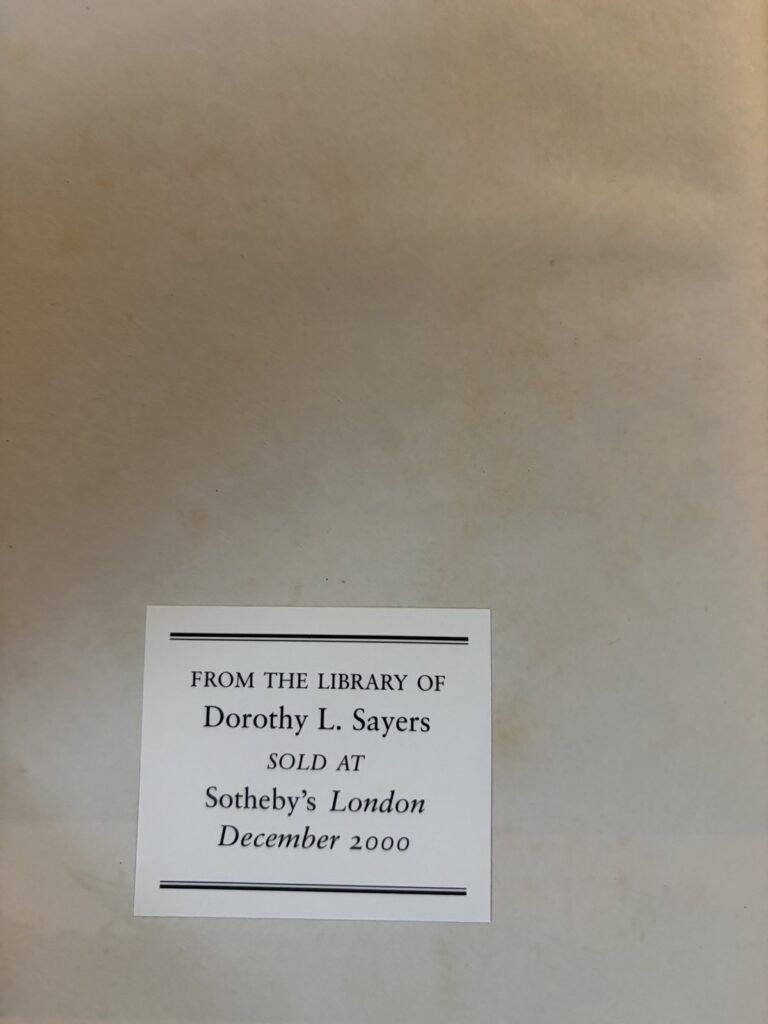
On Tuesday, December 19, 2000, Sotheby’s London held a sale of English Literature and History that included what the trade press called “the largest archive remaining in private hands” of Sayers material. There were manuscripts and typescripts of her plays, papers on religious subjects, a typescript of an unpublished Wimsey story, her own copies of her novels, and her personal library. Books from that library carry the label in this copy: “From the Library of Dorothy L. Sayers, Sold at Sotheby’s London, December 2000.”
This copy came out of that sale. I bought it from a collector who had acquired it from Sotheby’s. It’s a short, clean line of ownership, from Sayers’s own shelves, to the auction room, to one collector, to me. You won’t find a better provenance for a Sayers book. It has her signature on the page, the auction label inside the cover, and a published record of the sale that dispersed her library.
The Book: Approach to Greek Art
Approach to Greek Art was published by The Studio Publications, London and New York, in 1948. It has 132 pages of text, 108 plates and three supplementary plates, and it sold for 25 shillings. It was reviewed in The Spectator, Greece & Rome and Blackfriars.
The author, Charles Seltman (1886–1957), was a Fellow of Queens’ College, Cambridge, and a University Lecturer in Classics. He was best known for his work on Greek coins and won the Royal Numismatic Society’s medal in 1945. He wrote widely on Greek art and religion, including The Twelve Olympians (1952) and Women in Antiquity (1956). This book was his introduction to Greek art for general readers, from bronze and stone to coins and vases. He wrote it partly to argue that the way a society governs itself shows up in its art. The Greeks fascinated Sayers too. She was a classically trained translator who believed the old stories still mattered, so it’s easy to see why she wanted this book on her shelves.
Seltman and Sayers both died in 1957, six months apart.
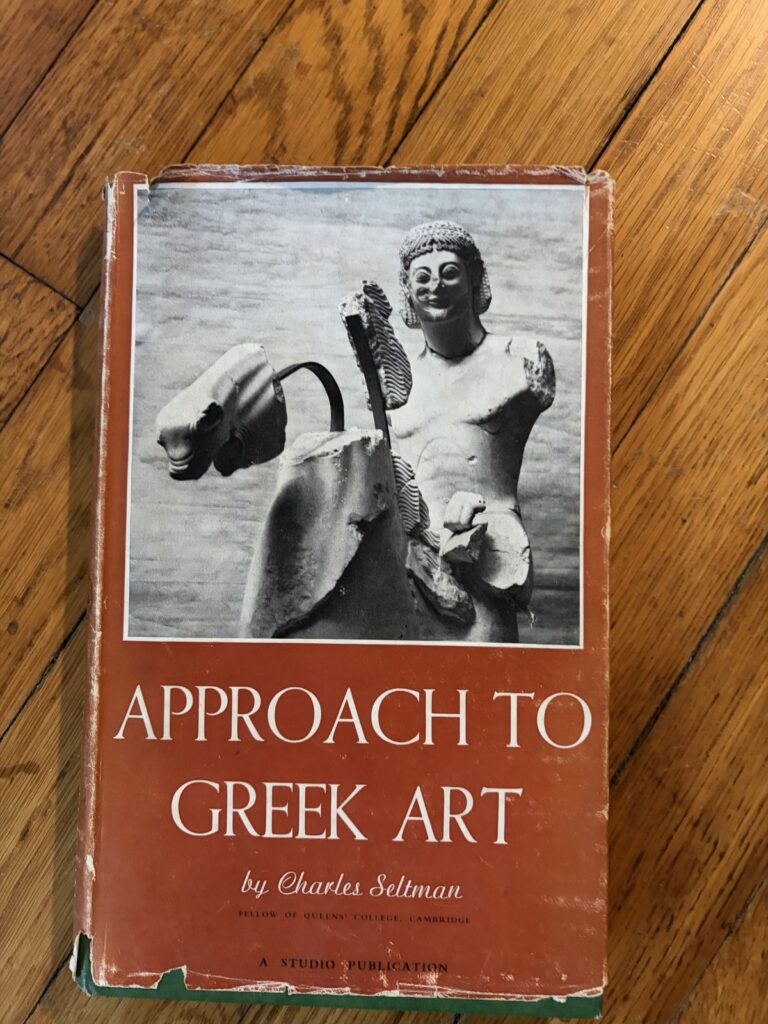
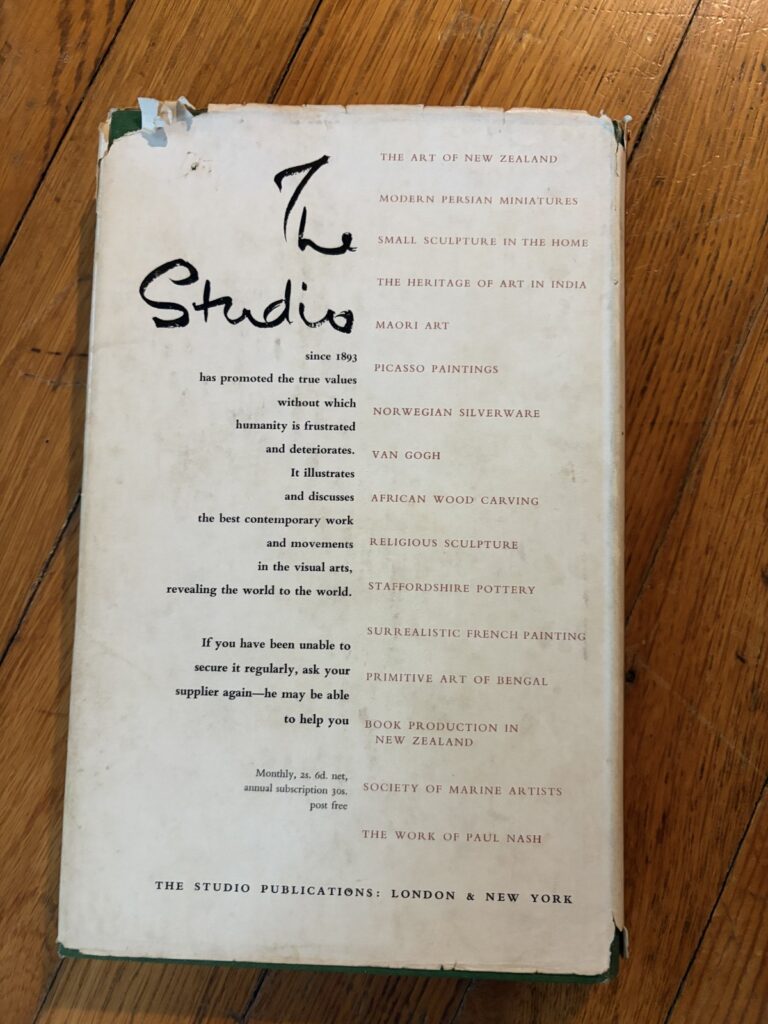
The dust jacket has a striking black-and-white photograph of an archaic terracotta figure, with the archaic smile, beaded hair and painted eyes, set on a rust-red ground. The back panel is a period advertisement for The Studio magazine (“since 1893”), listing features from Picasso to Staffordshire pottery to Paul Nash.
What’s Included
- Approach to Greek Art by Charles Seltman (The Studio Publications, London & New York, 1948), green cloth, in the original dust jacket
- Ownership signature “D. L. Sayers” in pencil, underlined, above the half-title
- “From the Library of Dorothy L. Sayers / Sold at Sotheby’s London / December 2000” provenance label on the front endpaper
Condition: The jacket shows wear you’d expect after nearly eighty years. It’s chipped and frayed at the head and foot of the spine and the corners, with small losses along the bottom edge of the front panel, rubbing, and some soiling to the white back panel. The front panel image and title are bright and intact. The endpapers are lightly toned. The pencil signature is clean and fully legible.
Why This Matters
Sayers material doesn’t come up often, and books from her own library are rarer still. Most of her papers are now in institutions like the Wade Center. Once a library is broken up, its books go out one by one, and most of them disappear into private collections.
This one comes with its whole history: her signature, the Sotheby’s label, and a published record of the sale that dispersed her library. For anyone who collects the Inklings and their circle, it’s a chance to own a book that sat on the shelves of the woman who argued theology with C.S. Lewis, took up Dante because of Charles Williams, and gave the world Lord Peter Wimsey.
How to bid
This book will be sold by silent bid.
- Email your bid to daniel@theolatte.com with the subject line “Bid: Dorothy L. Sayers’s Approach to Greek Art.”
- Include your name, your bid in U.S. dollars, and the best way to reach you.
- If your bid is close to what I’m looking for, I’ll follow up with you personally.
- You can view my ebay seller ratings and my etsy shop ratings/reviews to check on my standard of business. I’ve got good reviews and I want to make sure you are pleased.
- If your bid is accepted, you’ll send your payment through Venmo.
- If requested, and you send an acceptable bid, I can do a video call for you to better inspect your item before sending payment.
- After I receive your payment, I will send the item first class with sufficient insurance to cover the value and send you the tracking number.
Please bid responsibly. I won’t be haggling much over price, so send your best offer the first time. The bid you send is the one I’ll consider. If it is close, I’ll either send a notice of acceptance with directions for next steps, or a counter offer. If you don’t hear back within a few days, feel free to send a higher bid.

